Air Purifier for Cat Allergies: Complete Guide to Breathing Easy in 2025
Cat allergies affect 10-20% of adults worldwide, making felines the second most common indoor respiratory allergen after dust mites. Approximately 12 million Americans have given up cats due to allergies, yet 20% of the population would adopt one if allergens were manageable. This guide covers how air purifier cat allergy solutions work, which filters perform best, and how to maximize relief in your home.
My neighbor kept her three cats despite developing allergies in her 40s. She tried medications, weekly baths, and even considered rehoming her oldest tabby. Then she bought a HEPA air purifier for her bedroom. Within two weeks, she was sleeping through the night without congestion for the first time in months.
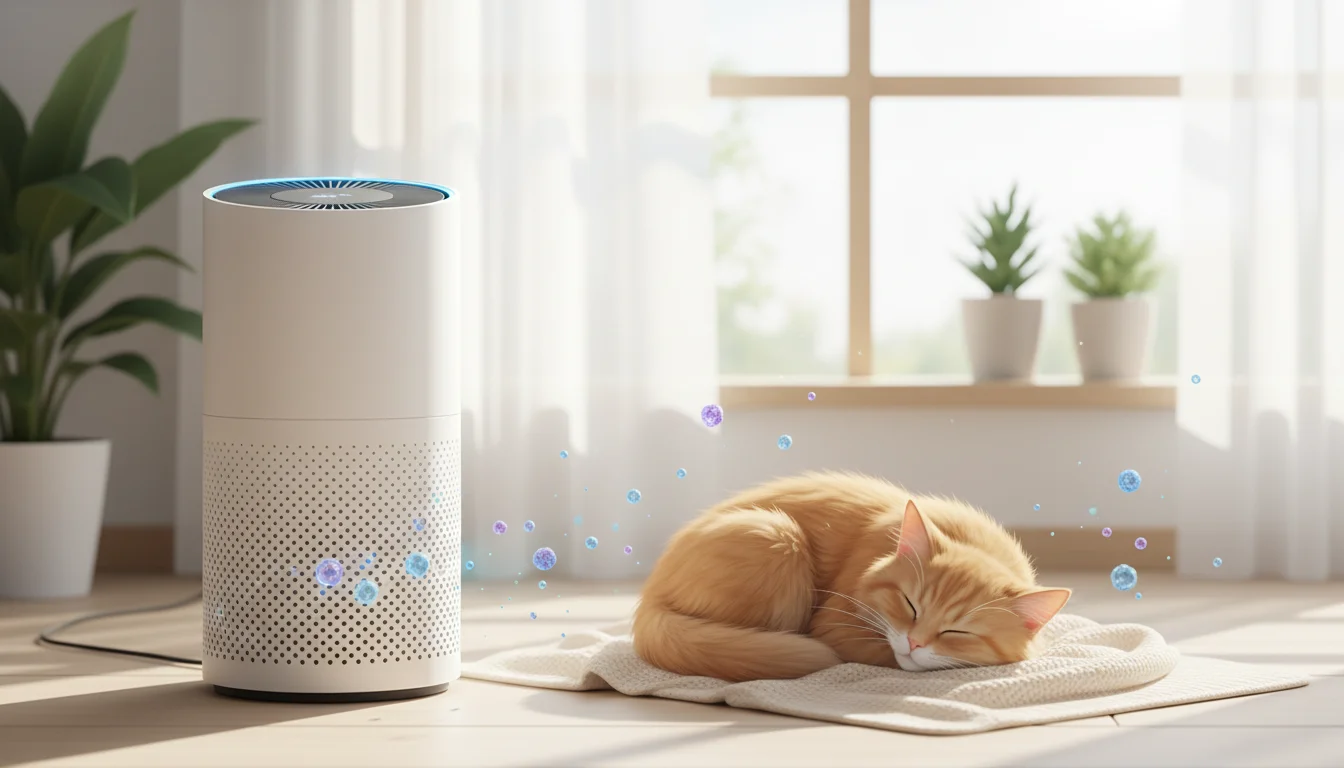
How Cat Allergens Work and Why Air Purifiers Help
Cat allergens trigger reactions through a protein called Fel d 1, produced in cat saliva, skin, and sebaceous glands. This protein causes the immune system to release histamine, leading to sneezing, itchy eyes, and asthma symptoms.
| Allergen Property | Details | Why It Matters |
|---|---|---|
| Protein responsible | Fel d 1 | Triggers 95% of cat allergic reactions |
| Particle size | 2.5 microns | Small enough to stay airborne for hours |
| Distribution | Saliva, skin, urine | Spreads through grooming onto fur |
| Persistence | Remains months after cat removal | Sticks to surfaces and recirculates |
| HEPA capture rate | 99.97% at 0.3 microns | Effectively traps cat dander particles |
Cat dander particles carrying Fel d 1 are incredibly small and sticky. They attach to clothing, furniture, and even travel to homes without cats. More than 90% of U.S. residences test positive for animal allergens regardless of pet ownership, according to Pacagen.
Air purifiers with HEPA filters continuously pull these microscopic particles from the air. Studies show reductions of 56-75% in airborne cat allergens when running a HEPA purifier consistently.
Types of Air Purifier Filters for Cat Allergies
True HEPA filters capture 99.97% of particles down to 0.3 microns, including Fel d 1 proteins attached to dander. Certification matters because HEPA-type filters lack standardized performance and vary widely in actual filtration capability.
| Filter Type | Primary Function | Cat Allergen Effectiveness | Considerations |
|---|---|---|---|
| True HEPA (certified) | Captures particles ≥0.3 microns | High—traps Fel d 1 proteins | Essential for allergy relief |
| HEPA-type (uncertified) | Variable particle capture | Uncertain—no performance guarantee | Avoid for serious allergies |
| Activated carbon | Removes odors and gases | Low—does not capture allergens | Best combined with HEPA |
| Pre-filter | Catches fur and large debris | Indirect—extends HEPA lifespan | Reduces maintenance costs |
| UV-C light | Kills microbes | Limited—no allergen removal | Potential ozone concerns |
| Ionizer | Settles particles to surfaces | Limited—particles resettle | May produce harmful ozone |
Dr. Niha Qamar, an allergy specialist, notes that a true HEPA filter with strong CADR ratings proves far more effective for allergen reduction than supplementary technologies like ionizers, according to Abaco Air Experts.
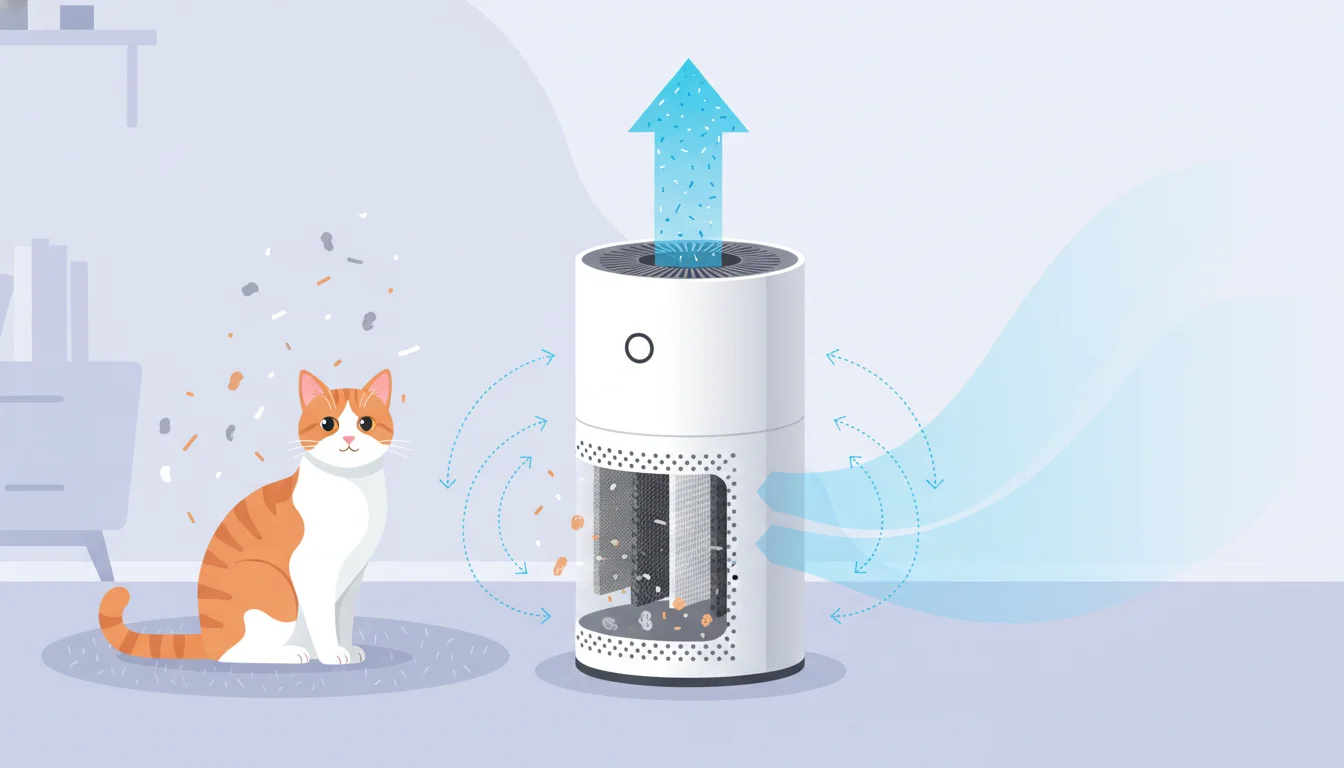
Multi-stage systems combining pre-filters, true HEPA, and activated carbon deliver the best results. The pre-filter catches fur before it clogs the HEPA. The carbon layer handles litter box odors. The HEPA does the heavy lifting on allergens.
Room Size and Placement Tips for Cat Homes
Match your air purifier's CADR rating to your room size using the two-thirds rule. A room measuring 300 square feet needs a purifier with at least 200 CADR for effective allergen removal.
- Primary placement: Position the purifier in rooms where your cat spends the most time during the day
- Bedroom priority: You spend 8 hours sleeping, making nighttime allergen exposure significant
- Clearance requirements: Keep 3-5 feet of space from walls and furniture for proper airflow circulation
- Height positioning: Floor level works best since cat dander settles downward over time
- Multi-room strategy: Two smaller units often outperform one large unit in homes with open floor plans
I learned the hard way that corner placement kills performance. Moving my purifier to the center of the room, near where my cat naps, made a noticeable difference within days.
Airborne cat allergen levels run much higher in rooms where cats are physically present. If your cat sleeps in your bedroom, that room needs a dedicated purifier running on medium or high throughout the night.
Budget vs Premium Air Purifiers: What's Worth the Cost
Budget air purifiers under $150 provide effective HEPA filtration for smaller spaces but run louder and lack smart features. Premium models above $400 offer whisper-quiet operation, larger coverage, and real-time air quality monitoring.
| Price Range | Room Coverage | Noise Level | Key Features | Annual Filter Cost |
|---|---|---|---|---|
| Budget ($50-150) | Up to 200 sq ft | 40-55 dB | Basic HEPA, manual controls | $30-50 |
| Mid-range ($150-400) | 200-500 sq ft | 25-45 dB | True HEPA, multiple speeds, timers | $50-80 |
| Premium ($400+) | 500-1000 sq ft | 20-35 dB | Medical-grade HEPA, app control, sensors | $80-120 |
Calculate total ownership cost before buying. A $100 purifier with $60 annual filter replacements costs $340 over four years. A $300 purifier with $80 filters costs $620. The premium unit covers more space and runs quieter but costs nearly double.
Compare air purifier costs against ongoing allergy medications. Prescription antihistamines run $30-100 monthly. A quality air purifier that pays for itself within a year makes financial sense for daily symptom sufferers.
Maintenance and Filter Replacement Schedule
HEPA filters in homes with cats need replacement every 6-12 months—faster than manufacturer recommendations for pet-free homes. Cat fur and dander accelerate filter saturation significantly.
- Pre-filter cleaning: Vacuum or rinse monthly to remove accumulated fur and extend HEPA life
- HEPA replacement: Every 6 months with one cat, every 4 months with multiple cats
- Carbon filter timing: Replace every 3-6 months based on odor control needs
- Visual inspection: Check for gray discoloration indicating heavy particle capture
- Symptom monitoring: Returning allergy symptoms often signal a saturated filter
Signs your filter needs changing include reduced airflow from the outlet, visible gray or brown coloring on white HEPA material, and allergy symptoms returning despite the purifier running. Trust your nose and your body over arbitrary timelines.
Set calendar reminders for filter checks. I forgot for 8 months once and wondered why my allergies had worsened. The filter looked like a felt blanket of gray cat fur.
Combining Air Purifiers with Other Allergy Strategies
Air purifiers work best as one component of a comprehensive allergen reduction system. Addressing allergens at the source while filtering the air delivers superior results compared to air purification alone.
- Grooming routine: Brush your cat outdoors 2-3 times weekly to reduce airborne dander
- HEPA vacuum use: Carpets hold 13 times more cat allergens than hard floors and require weekly vacuuming
- Bedding hygiene: Wash sheets and pillowcases weekly in water above 130°F to eliminate trapped allergens
- Cat-free zones: Keep cats out of bedrooms to create an allergen sanctuary for sleeping
- Surface wiping: Wipe furniture weekly with a damp cloth since cat allergens stick to surfaces
Some cat owners now feed diets containing IgY antibodies that neutralize Fel d 1 in cat saliva. Research shows a 30-50% reduction in allergens on cat hair within weeks of starting these specialized foods.
Fair warning: none of these strategies eliminate cat allergens completely. The goal is reduction to tolerable levels. Combining an air purifier with source control and cleaning creates cumulative benefits that single approaches cannot match.
FAQ
Do air purifiers completely eliminate cat allergies?
Air purifiers reduce airborne cat allergens by 56-75% but do not eliminate them entirely. They work best combined with regular cleaning, grooming, and creating cat-free zones in your home.
How long does it take for an air purifier to reduce cat allergens?
Noticeable improvement typically occurs within 24-48 hours of continuous operation. Full allergen reduction requires consistent use over 1-2 weeks as settled dander becomes airborne and gets filtered.
Should I run my air purifier 24/7 with cats?
Yes. Continuous operation provides the best results because cat dander constantly becomes airborne through movement and grooming. Running only at night misses daytime allergen accumulation.
Are more expensive air purifiers better for cat allergies?
Not necessarily. Any certified true HEPA filter captures cat allergens effectively. Premium models offer quieter operation and larger coverage, but a properly sized budget unit with true HEPA filtration performs equally well for allergen removal.
Do male cats produce more allergens than female cats?
Yes. Male cats produce higher levels of Fel d 1 protein than females. Neutered males produce less than intact males, making neutering beneficial for allergy-prone households.
Can I use an air purifier instead of allergy medication?
Air purifiers reduce allergen exposure but rarely replace medication entirely for moderate to severe allergies. Many people find they need lower medication doses or use them less frequently with consistent air purification.
Where should I place an air purifier if my cat sleeps in multiple rooms?
Prioritize your bedroom first since you spend 8 hours sleeping there. Consider a second unit for your cat's favorite daytime location. Portable units let you move one purifier between rooms as needed.
Do ionizers or UV-C features help with cat allergies?
Evidence for ionizer and UV-C effectiveness against cat allergens remains weak. Ionizers may produce ozone that irritates respiratory systems. Focus your budget on true HEPA filtration rather than supplementary technologies.
Share this post
Related Posts
UV Air Purifier for HVAC: Complete 2025 Guide to Cleaner Indoor Air
UV Air Purifier for HVAC: Complete 2025 Guide to Cleaner Indoor Air
Air Purifier With Window Open: Does It Work? (2025 Guide)
Air Purifier With Window Open: Does It Work? (2025 Guide)
Air Purifiers for Cigarette Smoke: What Actually Works (2025 Guide)
Air Purifiers for Cigarette Smoke: What Actually Works (2025 Guide)