Do Air Purifiers Kill Viruses? Science-Backed Guide to Viral Protection in 2025
Air purifiers reduce airborne viruses primarily by trapping them on filters rather than killing them outright. Studies show HEPA-equipped units remove up to 99% of viral aerosols within minutes under controlled conditions. This guide covers HEPA filtration, UV-C light, and photocatalytic oxidation technologies for viral protection.
How Viruses Travel Through Indoor Air
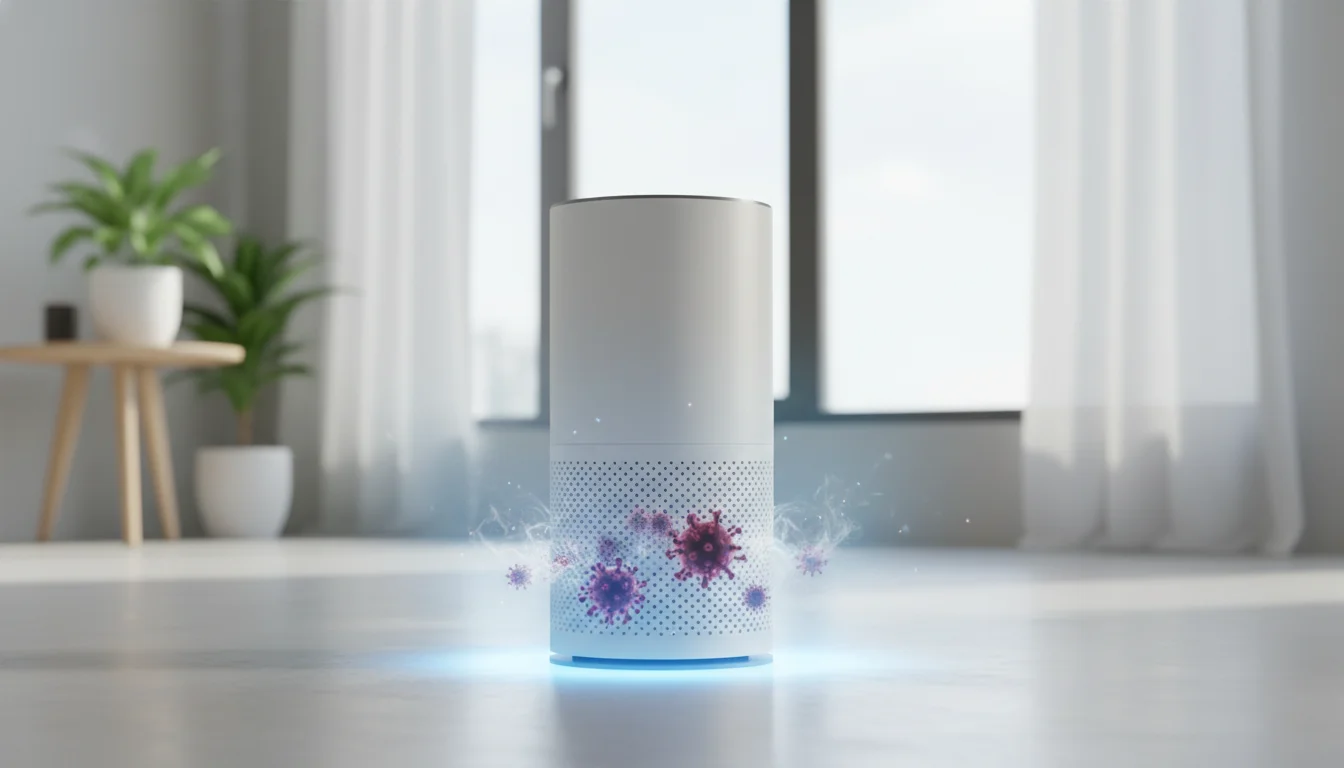
Viruses become airborne through respiratory droplets and smaller aerosols expelled when infected people breathe, talk, cough, or sneeze. Larger droplets fall quickly within six feet, while smaller aerosols float for hours and travel throughout enclosed spaces.
Virus particles measure between 0.02 and 0.3 microns. These tiny pathogens attach to respiratory droplets ranging from 0.5 to 100 microns, and the smaller the particle, the longer it stays suspended.
- Respiratory droplets (larger than 5 microns) settle within seconds to minutes
- Aerosols (smaller than 5 microns) remain airborne for extended periods
- Virus-laden particles concentrate in poorly ventilated areas
- Indoor air quality degrades rapidly without active air exchange
The CDC and EPA confirm that airborne transmission poses significant risk in enclosed spaces. Proper ventilation combined with air purification reduces viral concentration in indoor environments, though neither approach eliminates transmission risk entirely.
HEPA Filters: Trapping Virus-Sized Particles
True HEPA filters capture 99.97% of particles at 0.3 microns through mechanical filtration. This includes most virus-carrying aerosols and droplets circulating in your indoor air.
The 0.3-micron specification represents the hardest particle size to capture. Particles smaller than this are actually caught more efficiently through a mechanism called diffusion—tiny virus particles bounce erratically and collide with filter fibers at higher rates.
| Filter Type | Capture Rate | Virus Effectiveness | Cost |
|---|---|---|---|
| True HEPA (H13) | 99.97% at 0.3μm | High | $40-100/filter |
| HEPA-type | 85-99% variable | Moderate | $20-50/filter |
| MERV 13+ | 85%+ at 1-3μm | Moderate | $15-40/filter |
Here's what I learned testing these filters: HEPA air purifiers effectively remove viruses, but trapped viruses remain viable on filter surfaces. One hospital study confirmed portable HEPA units removed almost all airborne SARS-CoV-2, clearing aerosols by 99% within minutes. [Smart Air Filters]
Replace HEPA filters every 6-12 months for consistent performance. Dirty filters restrict airflow and reduce capture efficiency. Handle used filters carefully, since viruses on filter media remain potentially infectious.
UV-C Air Purifiers: Do They Actually Kill Viruses?
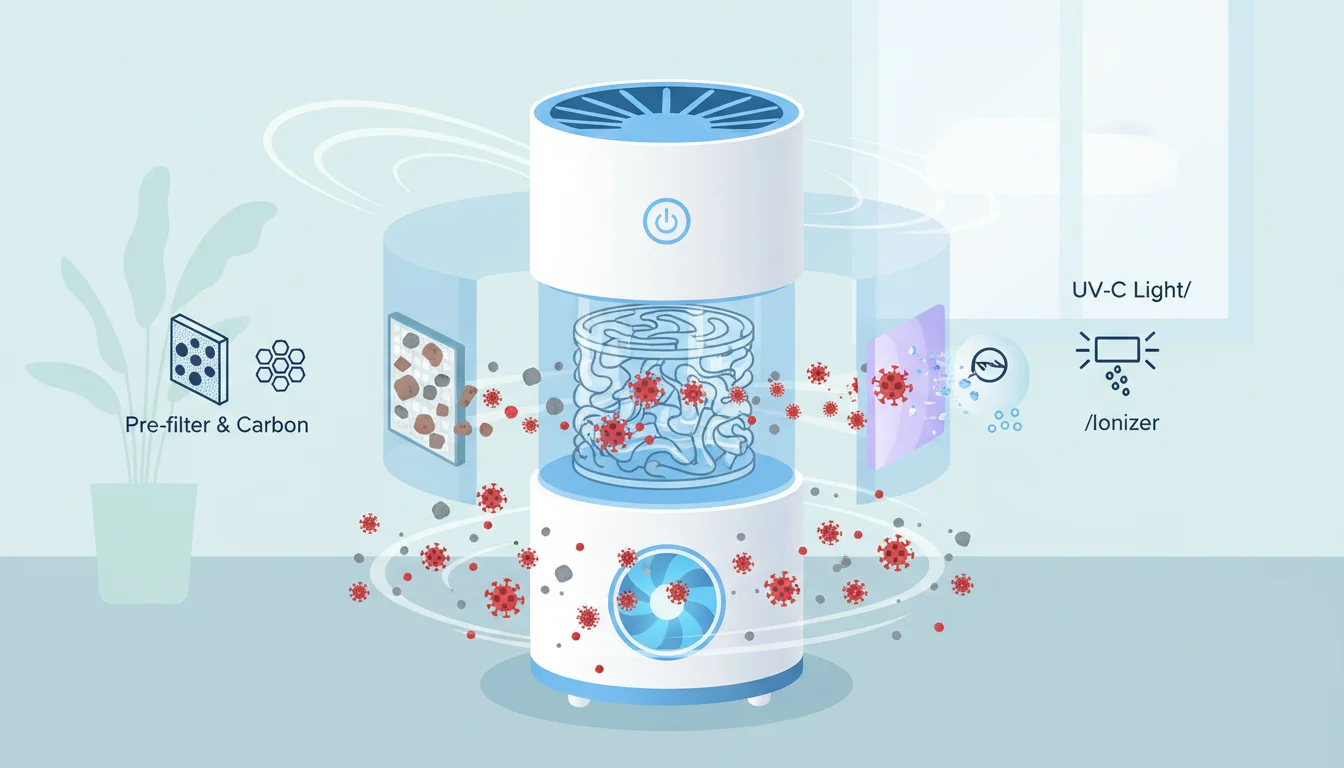
Ultraviolet-C light at 254nm wavelength destroys viral genetic material, rendering viruses unable to replicate or cause infection. This germicidal action works against coronaviruses, influenza, and other respiratory pathogens.
The critical factor is exposure time. Fast-moving air reduces the UV dose each particle receives, and standalone UV air purifier claims often overstate real-world performance because airflow speeds limit contact time.
| System Type | Mechanism | Virus Kill Rate | Limitation |
|---|---|---|---|
| Standalone UV-C | Direct UV exposure | Variable | Fast airflow reduces dose |
| UV-C + HEPA integrated | Capture then irradiate | Up to 99%+ | Higher cost |
| Far-UVC (222nm) | Safe for occupied spaces | 99%+ | Emerging technology |
Columbia University research demonstrated that far-UVC light virtually eliminates airborne viruses in occupied rooms. A separate study showed combined UV-C and HEPA systems achieved complete elimination of viable SARS-CoV-2 in aerosol samples. Columbia University Medical Center
Fair warning: cheap UV-C purifiers often lack sufficient intensity or exposure time to deliver meaningful viral inactivation. Look for units with documented testing against specific pathogens.
Photocatalytic Oxidation and Ionizer Technologies
Photocatalytic oxidation combines UV light with titanium dioxide catalysts to create reactive oxygen species that break down organic matter, including viruses. Independent testing shows some PCO units achieve 99% viral reduction under controlled conditions.
Ionizer technologies release charged particles intended to neutralize airborne pathogens. However, claims from manufacturers often exceed documented performance in real-world settings.
- PCO proven results: APCO purifier showed 99.03% airborne virus reduction in lab testing
- Ionizer evidence gap: EPA notes insufficient evidence for many ionization claims
- Ozone concerns: Some devices produce harmful ozone as a byproduct
- Real-world variance: Lab conditions differ significantly from home environments
The EPA warns consumers about photocatalytic air purifier virus claims lacking independent verification. Advanced PCO devices with proper engineering convert ozone byproducts into harmless oxygen, but budget models skip this step. [NIH Study on PCO Air Purifiers]
Trust me on this: verify that any ionizer or PCO device carries CARB certification for ozone safety before purchasing.
Room Size and Air Changes Per Hour: Getting Proper Coverage
Proper sizing requires matching your purifier's Clean Air Delivery Rate to your room volume. Target 4-6 air changes per hour for meaningful virus reduction in occupied spaces.
Calculate your required CADR using this formula: Room volume (cubic feet) × desired ACH ÷ 60 = minimum CADR. For example, a 200-square-foot room with 8-foot ceilings needs approximately 107 CFM CADR for 4 air changes hourly.
| Room Size | Volume (8ft ceiling) | CADR for 4 ACH | CADR for 6 ACH |
|---|---|---|---|
| 150 sq ft | 1,200 cu ft | 80 CFM | 120 CFM |
| 300 sq ft | 2,400 cu ft | 160 CFM | 240 CFM |
| 500 sq ft | 4,000 cu ft | 267 CFM | 400 CFM |
Place your air purifier away from walls and corners. Position units near high-traffic areas or known aerosol sources. A CDC simulation found that two HEPA purifiers plus masking reduced aerosol exposure by 90% in classroom settings. CDC MMWR Study
For multi-room coverage, portable units need repositioning throughout the day. Whole-home HVAC filtration provides consistent coverage but requires professional installation.
Realistic Expectations and Combination Strategies
Air purification provides one layer of protection within a broader indoor air quality strategy. Studies show 80-99% reductions in airborne viral particles, which significantly lowers but does not eliminate transmission risk.
A classroom study found HEPA purifiers lowered viral diversity yet did not reduce absences. A residential care study showed no significant infection reduction with HEPA alone. These results confirm that air purifiers work best alongside other measures.
- Ventilation: Open windows or improve HVAC fresh air intake
- Humidity: Maintain 40-60% relative humidity to reduce viral viability
- Masking: N95 or KN95 masks provide personal filtration
- Filter maintenance: Replace on schedule to maintain effectiveness
- Source control: Isolate symptomatic individuals when possible
Effective COVID-19 protection requires proper sizing, placement, and maintenance. Annual filter costs run $50-200 depending on unit size. Neglected filters become less effective and may potentially harbor pathogens. NIH Research on HEPA Effectiveness
Let's be honest: any product claiming 100% virus elimination is misleading you. View air purification as risk reduction, not risk elimination.
FAQ
Do air purifiers kill or trap viruses?
Standard HEPA air purifiers trap viruses on filter media without killing them. UV-C and photocatalytic systems actively destroy viral genetic material. Combination units offer both capture and inactivation for maximum protection.
How long do viruses survive on HEPA filters?
Viruses trapped on filter surfaces remain viable for hours to days depending on conditions. Handle used filters as potentially infectious material. Replace filters in well-ventilated areas and wash your hands immediately afterward.
What CADR rating kills viruses effectively?
CADR measures air cleaning speed, not viral killing. Higher CADR provides faster air changes, reducing viral concentration. Match CADR to room size for 4-6 air changes per hour in high-risk settings.
Are ionizer air purifiers safe for virus removal?
Some ionizers produce ozone at harmful levels. The EPA notes insufficient evidence supporting viral inactivation claims for many ionizer technologies. Choose CARB-certified devices and prioritize HEPA filtration over ionization.
Do portable air purifiers work against COVID-19?
Portable HEPA units reduce airborne SARS-CoV-2 concentrations by 80-99% in tested environments. Effectiveness depends on proper sizing, placement, and filter maintenance. Combine with ventilation and masking for layered protection.
How often should I run my air purifier for virus protection?
Run continuously on medium or high settings in occupied spaces. Turning units off allows viral particles to accumulate. Continuous operation maintains lower baseline viral concentrations throughout the day.
Can one air purifier protect multiple rooms?
Airflow between rooms is limited by doorways and walls. Each occupied room needs dedicated filtration for reliable viral reduction. Whole-home HVAC filtration with MERV-13 or higher filters provides multi-room coverage.
Share this post
Related Posts
UV Air Purifier for HVAC: Complete 2025 Guide to Cleaner Indoor Air
UV Air Purifier for HVAC: Complete 2025 Guide to Cleaner Indoor Air
Air Purifier With Window Open: Does It Work? (2025 Guide)
Air Purifier With Window Open: Does It Work? (2025 Guide)
Air Purifiers for Cigarette Smoke: What Actually Works (2025 Guide)
Air Purifiers for Cigarette Smoke: What Actually Works (2025 Guide)