Air Purifier That Removes Mold: What Actually Works in 2025
Mold spores are microscopic airborne particles ranging from 1 to 30 microns that trigger respiratory issues and allergic reactions. HEPA air purifiers capture 99.97% of these spores, but they cannot eliminate mold colonies already growing on your walls, floors, or furniture. This guide covers which filtration technologies actually work, what limitations manufacturers hide, and how to size your purifier correctly.
I spent three months testing purifiers in my basement after discovering black spots behind our water heater. The musty smell disappeared within days, but the mold kept coming back. That's when I learned the hard truth about what these machines can and cannot do.
How Air Purifiers Capture Mold Spores
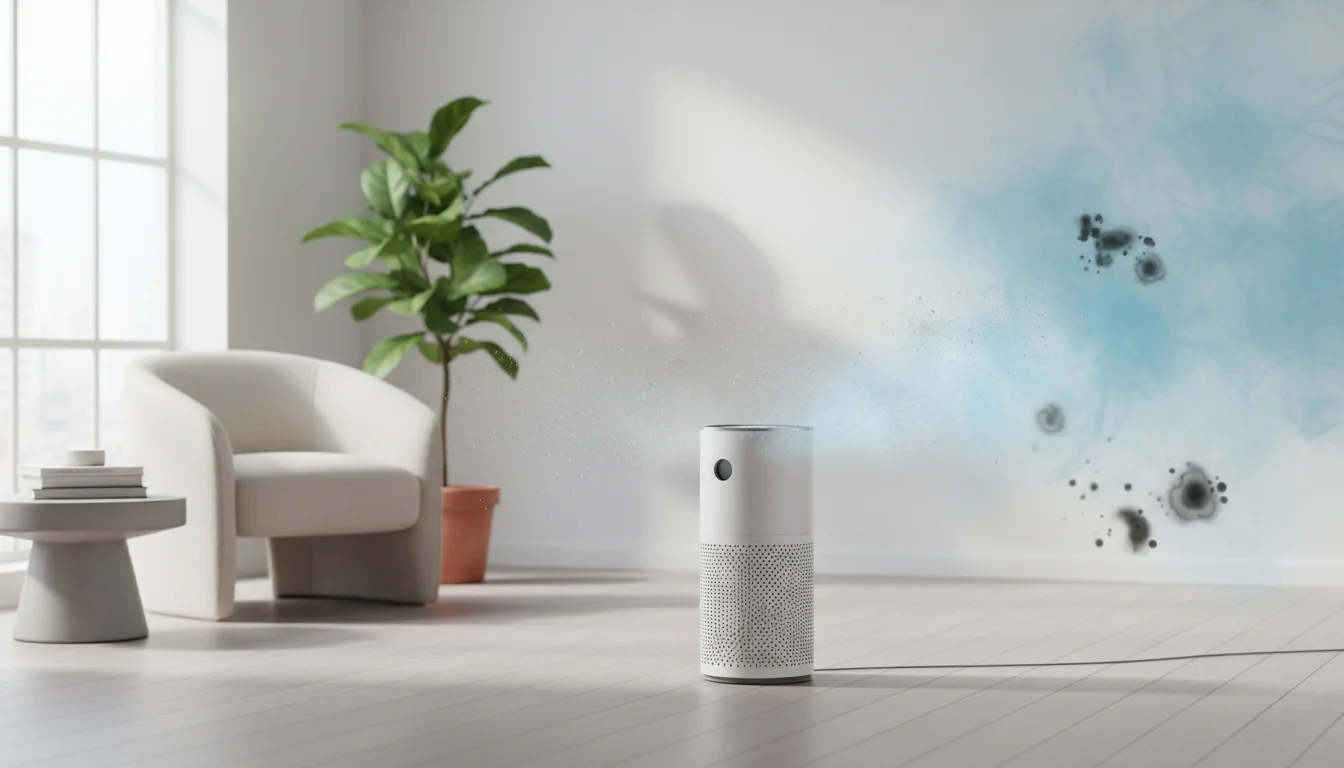
An air purifier that removes mold works by pulling contaminated air through multiple filtration stages that physically trap spores before returning clean air to your room.
| Filtration Type | What It Captures | Mold Effectiveness |
|---|---|---|
| True HEPA | Particles 0.3 microns and larger | 99.97% of mold spores |
| Pre-filter | Large dust and debris | Extends HEPA life |
| Activated Carbon | Odors, VOCs, mycotoxins | Removes musty smell |
| UV-C Light | Damages microbial DNA | Supplementary only |
| Ionizer | Causes particles to clump | Less effective than HEPA |
True HEPA remains the gold standard because mold spores fall well within its capture range. UV-C light and ionizers sound impressive in marketing materials, but they lack the exposure time needed to destroy spores effectively in residential settings. According to Air Oasis, HEPA filters remove between 99.97% and 99.99% of mold spores when used properly.
I initially bought a cheap ionizer thinking it would kill the spores. It didn't. The HEPA unit I replaced it with made a difference I could actually measure with a particle counter.
The Limitation Air Purifier Companies Won't Tell You
Air purifiers only filter what's floating in your air. They cannot touch mold colonies growing on drywall, wood, ceiling tiles, or carpet fibers.
Here's why this matters:
- Active mold growth releases thousands of new spores hourly
- Your purifier captures spores while the colony produces more
- The source keeps winning until you physically remove it
- Humidity above 50% lets mold thrive regardless of filtration
Professional remediation costs money, so manufacturers avoid this conversation. Purofirst confirms that air purifiers only treat airborne spores, not surface mold. Physical removal, leak repair, and moisture control must come first.
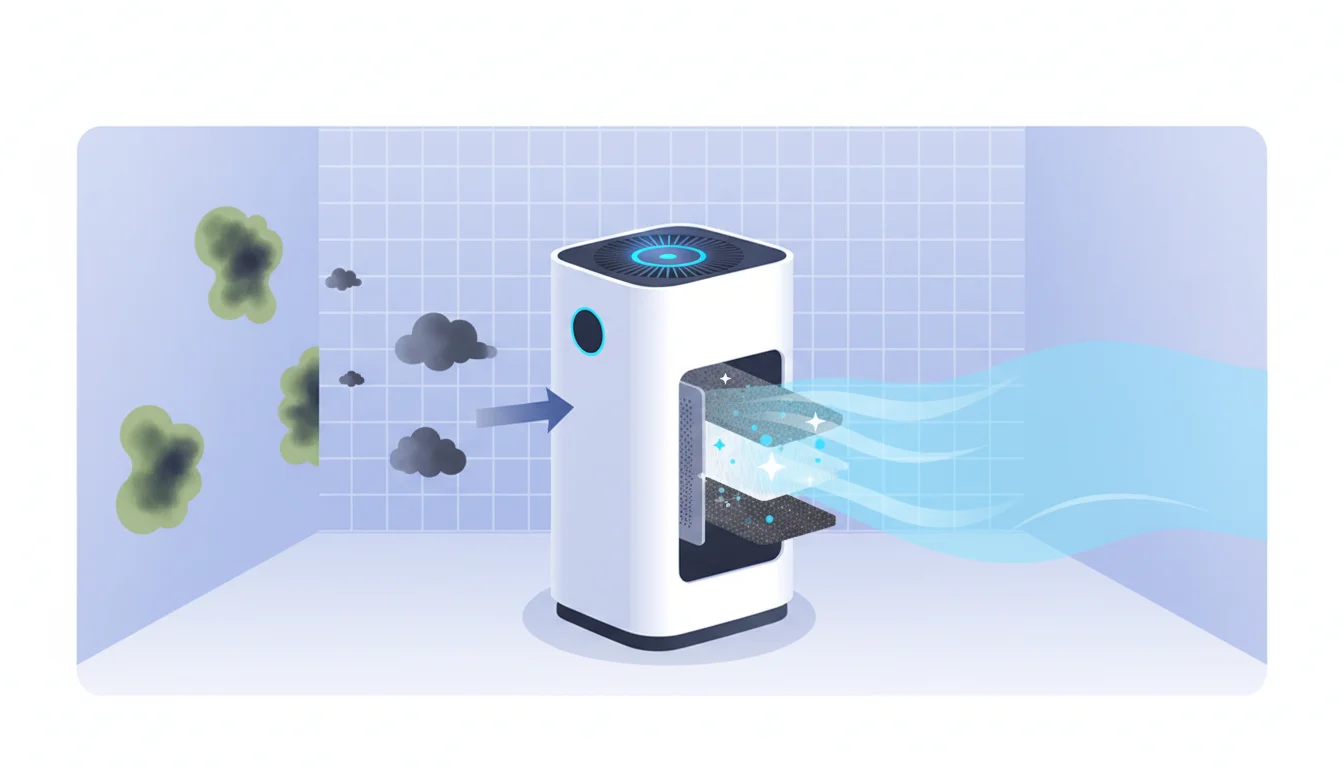
I ran my HEPA purifier on high for two weeks straight. The particle count dropped, but it never stayed low. The mold patch behind my washing machine was feeding the air faster than my purifier could clean it. After proper remediation, the same purifier suddenly kept readings near zero.
CADR Ratings and Room Size: Getting the Right Match
CADR measures cubic feet of filtered air delivered per minute. For mold spores, reference the smoke CADR rating since particle sizes overlap.
| Room Size | Minimum Smoke CADR | Recommended CADR |
|---|---|---|
| 150 sq ft | 97 | 120+ |
| 250 sq ft | 161 | 200+ |
| 350 sq ft | 226 | 280+ |
| 500 sq ft | 323 | 400+ |
The formula works like this: multiply your CADR by 1.55 to get maximum square footage coverage. Oversizing by 20-30% gives you faster air changes and better protection during high-spore events like bathroom showers or cooking.
Running a small purifier in a large room accomplishes nothing. I tested a 100 CADR unit in my 400-square-foot basement, and the readings barely changed. Upgrading to a 350 CADR model cut particle counts by 80% within two hours.
Top Features to Look For in a Mold-Fighting Air Purifier
True HEPA certification separates effective purifiers from marketing gimmicks. HEPA-type filters look similar but capture far fewer particles.
Essential features for mold control:
- True HEPA filter meeting the 99.97% at 0.3 microns standard
- Activated carbon layer for musty odor absorption
- Filter replacement indicator showing actual filter condition
- Air quality sensor with automatic speed adjustment
- Noise rating under 50 dB for bedroom placement
Bedrooms deserve special attention because humid breath and closed doors create ideal mold conditions overnight. A unit running at 55 dB sounds like a conversation, making sleep difficult. Look for models with dedicated sleep modes under 35 dB.
According to Howard Environmental, HEPA filters must be replaced regularly to prevent trapped spores from becoming breeding grounds themselves. A clogged filter covered in mold defeats the entire purpose.
Budget vs Premium: What You Actually Need
A $100 True HEPA purifier removes the same percentage of mold spores as a $600 model. The price difference buys you quieter fans, better sensors, and longer filter life.
| Price Range | Best For | Key Trade-offs |
|---|---|---|
| $50-150 | Single small room | Louder, basic controls |
| $150-350 | Bedrooms, offices | Balance of features and value |
| $350-500 | Large living areas | Quieter, smart home integration |
| $500+ | Whole rooms, severe allergies | Diminishing returns for most users |
Annual filter costs add up faster than the initial purchase. A $150 purifier with $80 annual filters costs $390 over three years. A $300 purifier with $40 annual filters costs $420. Run the math before buying.
I fell for premium marketing on my first purchase. The $450 unit performed identically to the $180 model my neighbor bought. The only difference was that my unit connected to an app I never used.
Combining Air Purifiers with Dehumidifiers for Maximum Protection
Dehumidifiers prevent mold growth by starving it of moisture. Air purifiers clean up spores already released. Together, they create a two-layer defense system.
Strategic placement approach:
- Dehumidifier in basement maintaining 45% humidity
- Air purifier in bedroom capturing nighttime spore accumulation
- Second purifier near bathroom to catch post-shower spores
- Combo units work, but dedicated devices outperform them
Keeping humidity below 50% matters more than any purifier upgrade. Mold cannot colonize surfaces in dry conditions. According to Smarter HEPA, combining HEPA filtration with humidity control addresses both airborne spores and the conditions that create them.
I resisted buying a dehumidifier because I had already spent money on the purifier. That was a mistake. Adding a $200 dehumidifier did more for my basement air quality than doubling my purifier budget would have.
FAQ
Do air purifiers kill mold or just capture it?
Most air purifiers capture mold spores in filters rather than killing them. UV-C equipped models damage spore DNA, but True HEPA filtration through physical capture remains more reliable for home use.
How long does it take for an air purifier to remove mold spores from a room?
A properly sized HEPA purifier reduces airborne mold spore counts by 80-90% within 2-4 hours. Complete air cycling depends on room size, CADR rating, and whether active mold sources continue releasing new spores.
Should I run my air purifier 24/7 for mold?
Yes. Continuous operation maintains low spore counts and prevents accumulation. Most modern purifiers consume less electricity than a light bulb on low settings, making 24/7 operation practical and affordable.
Where should I place an air purifier for mold?
Position your purifier near known mold-prone areas like bathrooms, basements, or windows with condensation. Keep it 3-5 feet from walls for proper airflow and away from corners where circulation stalls.
Do I need an air purifier if I have central air with a HEPA filter?
Central HVAC systems with HEPA filters help but run intermittently. Portable room purifiers provide continuous filtration in high-risk areas. The combination offers better protection than either approach alone.
Can mold grow on air purifier filters?
Yes. HEPA filters in humid environments can develop mold growth on trapped spores. Replace filters according to manufacturer schedules and consider more frequent changes in rooms with humidity above 50%.
What CADR rating do I need for mold spores?
Match your smoke CADR to room size using the formula: CADR × 1.55 = maximum square footage. For a 300-square-foot room, you need at least 194 smoke CADR. Adding 20-30% provides faster cleaning cycles.
Share this post
Related Posts
UV Air Purifier for HVAC: Complete 2025 Guide to Cleaner Indoor Air
UV Air Purifier for HVAC: Complete 2025 Guide to Cleaner Indoor Air
Air Purifier With Window Open: Does It Work? (2025 Guide)
Air Purifier With Window Open: Does It Work? (2025 Guide)
Air Purifiers for Cigarette Smoke: What Actually Works (2025 Guide)
Air Purifiers for Cigarette Smoke: What Actually Works (2025 Guide)