Best Air Purifiers to Remove Smoke Smell: Complete Buying Guide 2025
Smoke odor contains both fine particles and volatile organic compounds that standard air fresheners only mask. An air purifier to remove smoke smell with HEPA and activated carbon filtration captures 99.97% of particles down to 0.3 microns while adsorbing odor-causing gases. This guide covers the science, top models, and strategies for eliminating smoke smell from your home.
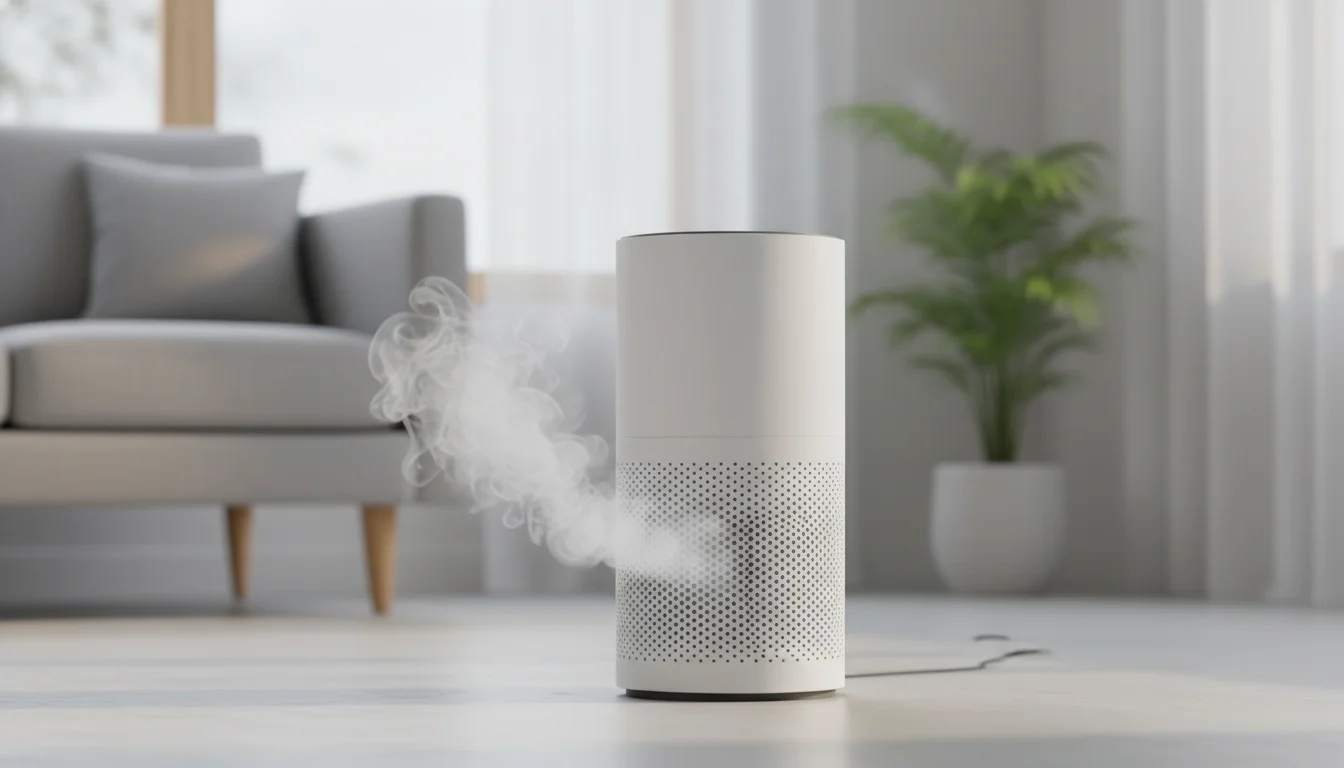
How Air Purifiers Remove Smoke Smell: The Science Behind Odor Elimination
Smoke particles and odor molecules require two different filtration methods working together. HEPA filters trap visible particulates like soot and ash, while activated carbon adsorbs the invisible VOCs that cause lingering smell.
Here's what happens at the molecular level:
- Smoke composition: Contains particles ranging from 0.01 to 4 microns plus gaseous compounds
- HEPA filtration: Captures solid particulate matter through a dense fiber mesh
- Carbon adsorption: Millions of microscopic pores trap VOC molecules through chemical bonding
- Surface area: A single activated carbon pellet has the equivalent surface area of a football field
- Combined systems: Dual-stage filters address both particle and gas-phase pollutants simultaneously
One key insight: running a purifier on high speed initially clears smoke quickly, then lower speeds maintain air quality. According to [Sensibo], the best smoke odor removal comes from purifiers that integrate both HEPA and thick activated carbon layers.
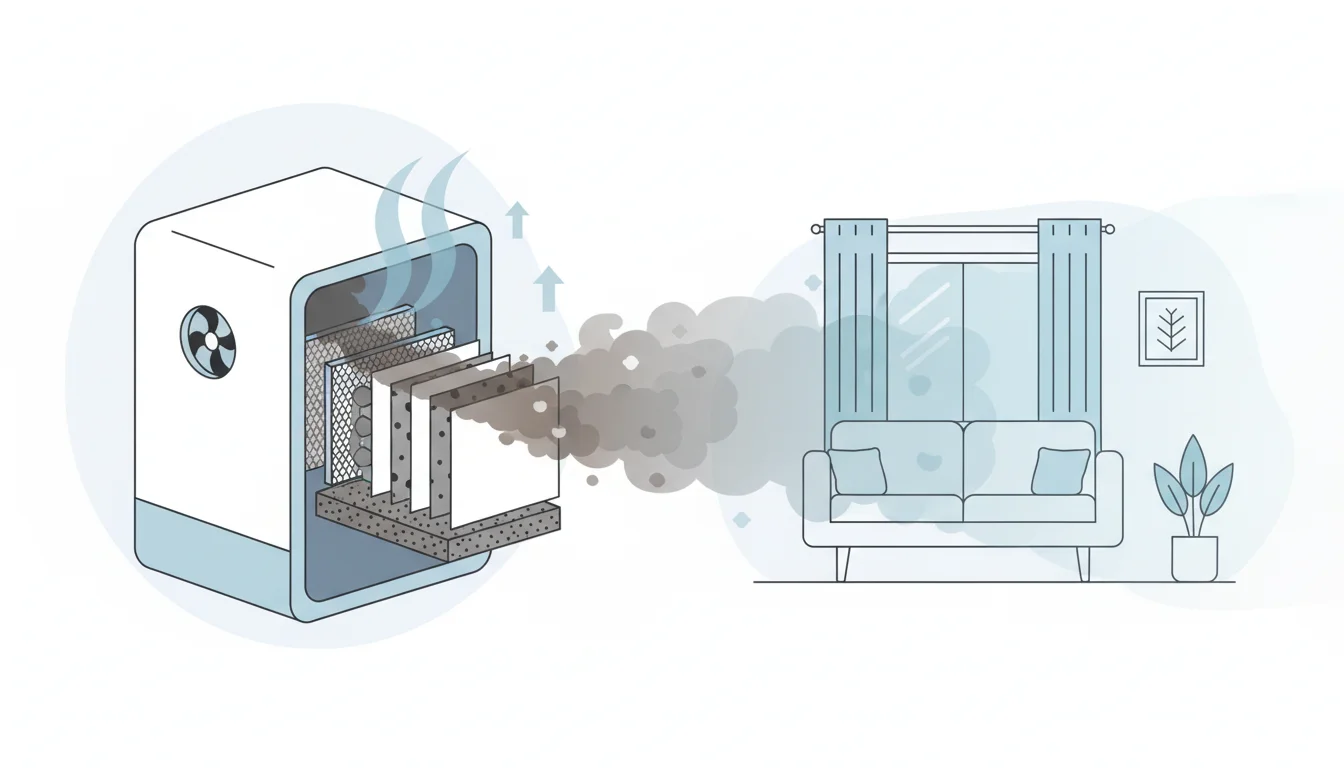
Activated Carbon vs HEPA: Which Filter Type Works Best for Smoke?
You need both filter types, but carbon does the heavy lifting for odor removal. HEPA handles what you see; carbon handles what you smell.
| Filter Type | What It Removes | Smoke Effectiveness | Lifespan in Smoke Environments |
|---|---|---|---|
| True HEPA | Particles 0.3 microns and larger | Excellent for soot and ash | 6-12 months |
| Thin Carbon Sheet | Light VOCs and odors | Poor for heavy smoke | 1-2 months |
| Pelletized Carbon (3-5 lbs) | VOCs, gases, strong odors | Excellent for cigarette/cigar smoke | 3-6 months |
| Granular Carbon (10+ lbs) | Heavy VOCs, chemical gases | Professional-grade smoke removal | 6-12 months |
The difference between carbon types matters more than most buyers realize. Thin carbon sheets saturate within weeks in smoky environments, while pelletized or granular carbon at 3 pounds minimum handles sustained smoke exposure. Fair warning: budget purifiers with paper-thin carbon layers will disappoint you.
Intellipure confirms that activated carbon combined with HEPA provides the best solution because carbon absorbs gaseous odor components while HEPA traps particulate matter.
Top Air Purifiers for Cigarette, Cigar, and Weed Smoke in 2025
The Austin Air HealthMate Plus Jr. leads for heavy indoor smoking with 6.5 pounds of activated carbon, while the IQAir HealthPro Plus offers professional-grade performance. Your choice depends on room size, smoke intensity, and budget.
| Model | Carbon Weight | CADR (CFM) | Room Coverage | Best For | Price Range |
|---|---|---|---|---|---|
| Austin Air HealthMate Plus Jr. | 6.5 lbs | 200 | 300 sq ft | Heavy daily smoking | $500-600 |
| IQAir HealthPro Plus | Professional-grade | 260 | 406 sq ft | Cigar lounges, serious smoke | $900-1,000 |
| Levoit Core 600S | Compact | 410 | 635 sq ft | Large rooms, secondhand smoke | $250-300 |
| Winix 5510 | Pellet-based | 253 | 392 sq ft | Budget-conscious smokers | $150-200 |
| Alen BreatheSmart FLEX | 2+ lbs | 220 | 400 sq ft | Mid-range, long filter life | $300-400 |
| Germ Guardian 4-in-1 | Standard | 180 | 1,000 sq ft | Light smoke, large coverage | $100-150 |
The Levoit Core 600S cleared smoke in testing within 9 seconds—the fastest result recorded by [Air Purifier First]. For weed smell specifically, models with 4+ pounds of carbon work best since cannabis smoke contains heavier terpene compounds.
One piece of advice: buy more carbon capacity than you think you need. Undersized units run constantly at high speed and burn through filters quickly.
Room Size and Placement: Maximizing Smoke Odor Removal Effectiveness
Choose a purifier rated for a room 50% larger than your actual space to achieve faster air cycling. A 300-square-foot room needs a unit rated for 450+ square feet when smoke is involved.
Placement strategies that work:
- Near smoke source: Position within 6-10 feet of where smoking occurs
- Central location: Avoid corners and areas behind furniture that block airflow
- Elevated position: Smoke rises, so table-height placement captures more
- Clear surroundings: Maintain 2-3 feet of clearance on all sides
- Multiple units: Open floor plans need purifiers in each zone
Speed settings also affect effectiveness. Run on high during smoking and for 30 minutes afterward, then switch to medium for ongoing maintenance. Low settings work well for overnight operation when noise matters.
The CADR rating tells you how many cubic feet of clean air the unit delivers per minute. Match this number to your room's square footage at minimum. For smoke removal, doubling this ratio produces noticeably better results.
Filter Replacement and Ongoing Costs: What to Expect
Carbon filters in smoky homes need replacement every 3-6 months versus the 12-month lifespan advertised for normal use. Plan your budget accordingly before purchasing.
| Cost Factor | Light Smoke Use | Heavy Smoke Use |
|---|---|---|
| Carbon filter lifespan | 6-9 months | 2-4 months |
| HEPA filter lifespan | 12 months | 6-9 months |
| Annual filter cost (budget models) | $50-75 | $100-150 |
| Annual filter cost (premium models) | $100-150 | $200-300 |
| 5-year total ownership | $400-600 | $800-1,200 |
Signs your carbon filter needs replacement:
- Smoke smell returns despite running the purifier
- Reduced airflow from the unit
- Visible discoloration on the filter surface
- Unit has run continuously for 500+ hours in smoke
Some brands offer subscription discounts of 10-20% on replacement filters. Calculate the 3-year cost of ownership before committing to a model. A cheaper unit with expensive filters often costs more long-term than a premium unit with reasonable replacement costs.
Combining Methods: Air Purifiers Plus Other Smoke Removal Strategies
Air purifiers work best as part of a multi-pronged approach. Smoke particles settle on every surface and require physical removal alongside air filtration.
Complementary strategies:
- Ventilation: Open windows for 15-20 minutes daily when weather permits
- Surface cleaning: Wipe hard surfaces weekly since smoke residue accumulates
- Fabric treatment: Sprinkle baking soda on upholstery and vacuum after 30 minutes
- Closet protection: Place activated charcoal bags to prevent smoke absorption into clothing
- Air quality monitoring: Track PM2.5 levels to optimize purifier settings objectively
The reality is that no single solution eliminates smoke smell completely. The purifier handles airborne particles and gases while you handle surface contamination. Together, these approaches produce results that neither achieves alone.
FAQ
Do air purifiers completely eliminate cigarette smoke smell?
They remove 90-95% of smoke particles and odors when properly sized with adequate carbon filtration. Complete elimination requires combining purification with surface cleaning and ventilation. Third-hand smoke residue on fabrics and walls needs separate treatment.
How long does an air purifier take to clear smoke from a room?
Top-performing units clear visible smoke in 9-30 seconds. Odor elimination takes 15-45 minutes depending on room size and purifier CADR rating. Running on high speed during this initial period produces the fastest results.
Can a cheap air purifier remove smoke smell effectively?
Budget models under $100 with thin carbon sheets struggle with anything beyond light, occasional smoke. Expect to spend $150-300 minimum for effective cigarette smoke removal. The carbon filter weight matters more than the brand name.
Do ionizers or ozone generators work for smoke removal?
Ionizers help particles settle faster but don't remove odors. Ozone generators pose respiratory health risks and are not recommended for occupied spaces. Stick with HEPA and activated carbon for safe, effective smoke removal.
Where should I place my air purifier for smoke?
Position the unit 6-10 feet from the smoke source at table height or higher. Maintain 2-3 feet of clearance around all sides. Avoid corners, closets, and areas behind furniture where airflow becomes restricted.
How often should I run my air purifier for smoke smell?
Run continuously on low or medium in homes with regular smoking. Increase to high speed during active smoking and for 30 minutes afterward. Overnight operation on low maintains air quality without disturbing sleep.
Will an air purifier help with smoke smell from neighbors?
Yes, if smoke enters through shared walls, vents, or windows. Place the purifier near the entry point and run on medium-high. Sealing gaps around doors, windows, and outlets also reduces smoke infiltration from adjacent units.
Can I use an air purifier for wildfire smoke?
HEPA filters excel at capturing fine wildfire particulates, and carbon filters help with the smoky odor. Choose a unit with a high CADR rating and run it continuously during smoke events with windows and doors sealed.
Share this post
Related Posts
UV Air Purifier for HVAC: Complete 2025 Guide to Cleaner Indoor Air
UV Air Purifier for HVAC: Complete 2025 Guide to Cleaner Indoor Air
Air Purifier With Window Open: Does It Work? (2025 Guide)
Air Purifier With Window Open: Does It Work? (2025 Guide)
Air Purifiers for Cigarette Smoke: What Actually Works (2025 Guide)
Air Purifiers for Cigarette Smoke: What Actually Works (2025 Guide)