Air Purifier vs Dehumidifier: Which One Do You Actually Need in 2025?
Air purifiers remove airborne particles like dust, pollen, and smoke using HEPA filtration, while dehumidifiers extract excess moisture from the air. The EPA recommends maintaining indoor humidity between 30-50% to prevent mold growth and dust mite proliferation. This guide breaks down exactly which device solves your specific indoor air quality problem.
I spent three months running both devices in my basement before understanding what each one actually does. The musty smell that drove me crazy? That was a humidity problem, not a particle problem. Once I figured that out, everything clicked.
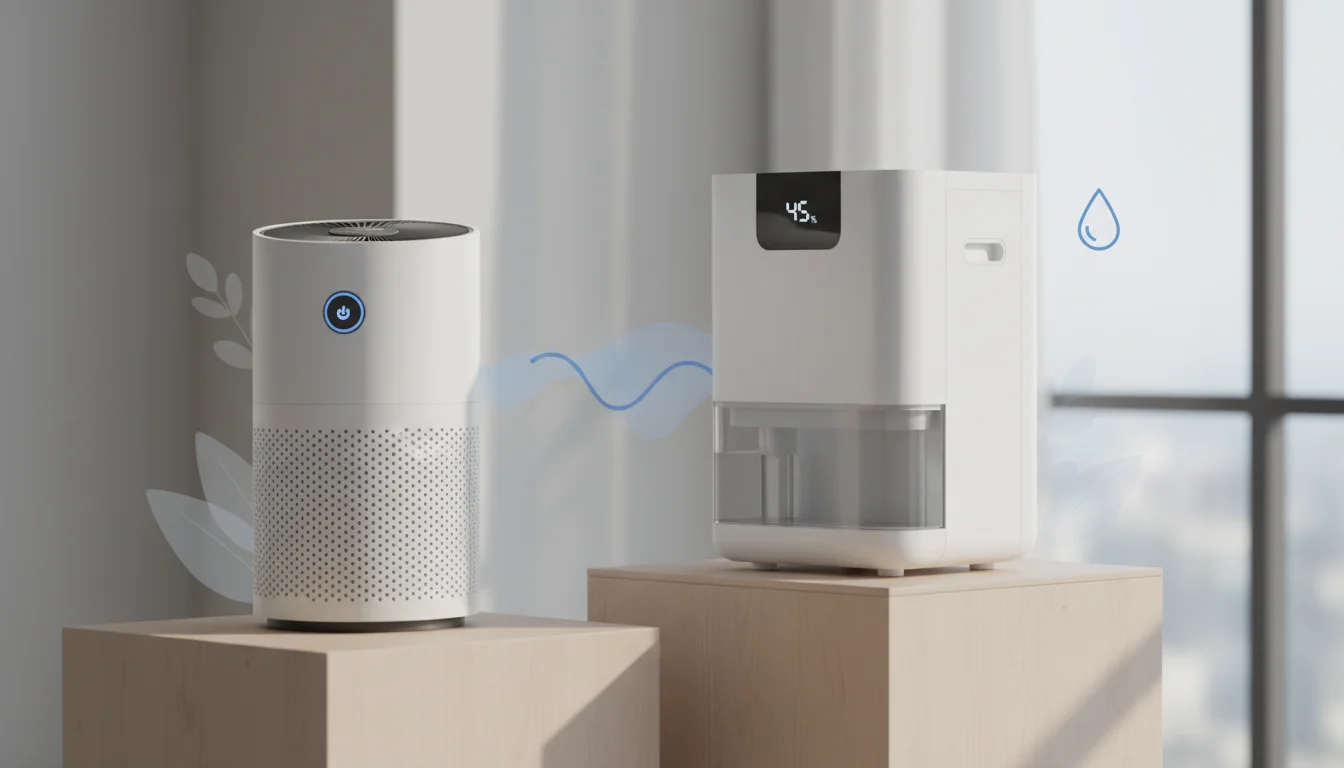
What's the Difference Between an Air Purifier and a Dehumidifier?
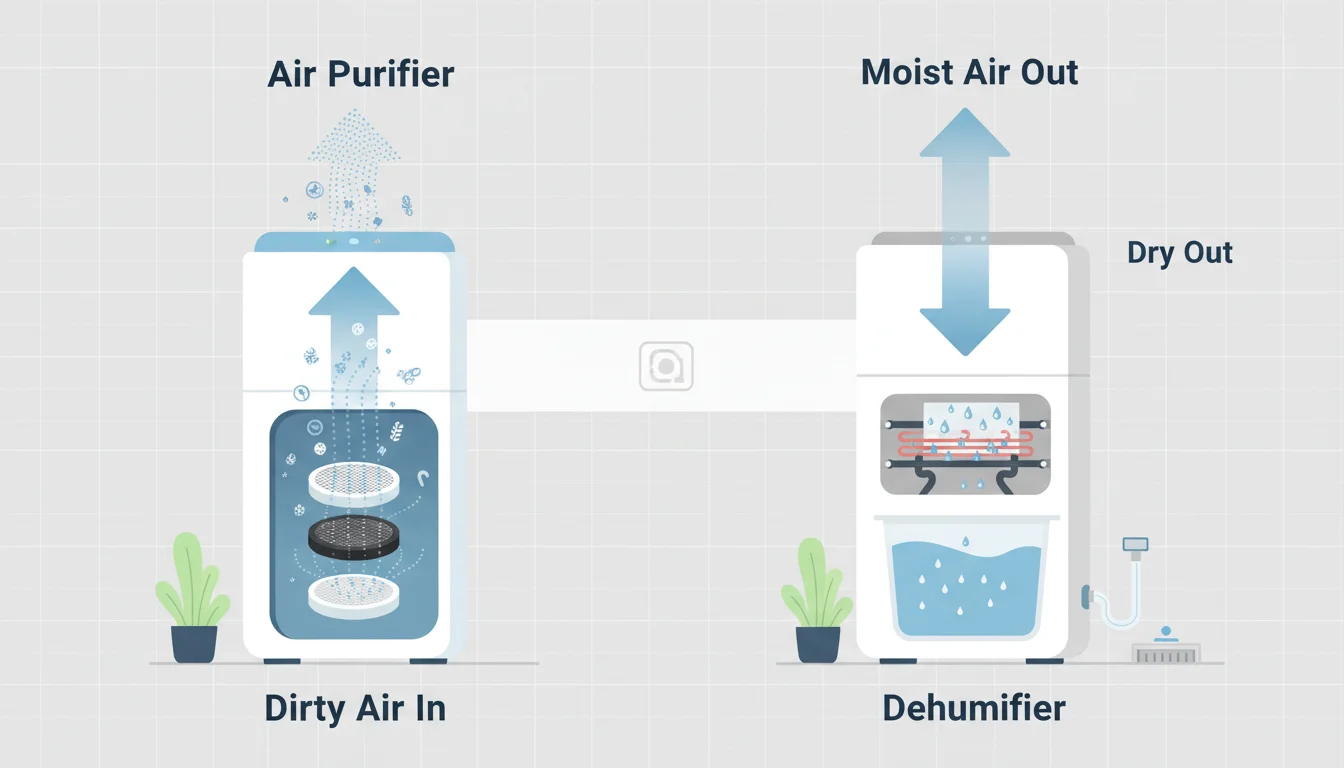
Air purifier vs dehumidifier comes down to one core distinction: air purifiers filter particles from the air, while dehumidifiers remove water vapor. These devices solve completely different problems and cannot substitute for each other.
| Feature | Air Purifier | Dehumidifier |
|---|---|---|
| Primary Function | Removes airborne particles | Extracts moisture from air |
| What It Removes | Dust, pollen, smoke, pet dander, mold spores | Water vapor, humidity |
| Filtration System | HEPA filter, activated carbon | No air filtration capability |
| Effect on Humidity | None | Reduces humidity to 30-50% |
| Effect on Particles | Captures 99.97% of particles 0.3 microns+ | None |
| Ideal Room Conditions | Any humidity level | High humidity above 50% |
The 50% humidity threshold matters more than most people realize. Above this level, mold and dust mites flourish in your home. Below 30%, you risk dry skin and respiratory irritation. Dehumidifiers maintain this sweet spot, but they lack filters entirely and cannot clean your air of pollutants HouseFresh.
Think of it this way: air purifiers address what's floating in your air, while dehumidifiers address the moisture content. Neither replaces the other.
When to Choose an Air Purifier
Air purifiers work best when your problem involves airborne particles rather than moisture. They capture allergens, smoke, and other pollutants through mechanical filtration, making them essential for respiratory health.
- Allergy sufferers: HEPA filters trap pollen, dust, and pet dander before you breathe them
- Asthma management: Reduces airborne irritants that trigger attacks
- Smoke and wildfire concerns: Captures fine particulate matter from outdoor air pollution
- Pet owners: Removes dander and hair floating in the air
- Odor control: Activated carbon filters neutralize VOCs and household smells
- Urban environments: Filters outdoor pollution entering through windows and doors
Look for a HEPA filter that captures 99.97% of particles 0.3 microns and larger. Match the CADR (Clean Air Delivery Rate) to your room size—a unit with 200 CADR handles roughly 300 square feet effectively Coway.
Fair warning: if your allergies stem from dust mites specifically, you need humidity control first. Dust mites thrive in humid environments. An air purifier catches them once airborne, but a dehumidifier stops them from multiplying in the first place.
When to Choose a Dehumidifier
Dehumidifiers solve moisture problems at their source by pulling water vapor from the air and collecting it in a tank. Choose one when dampness threatens your health or your home's structure.
- Basement dampness: Underground spaces naturally accumulate moisture year-round
- Visible mold growth: Control humidity below 50% to stop mold proliferation
- Musty odors: These smells signal excess moisture, not airborne particles
- Window condensation: Water droplets on glass indicate high indoor humidity
- Peeling wallpaper or paint: Moisture damage to walls and finishes
- Humid climates: Summer months bring indoor humidity spikes
- Wood furniture protection: Excess moisture warps and damages wooden items
According to the CDC and WHO, keeping humidity between 30-50% prevents mold growth and creates an inhospitable environment for dust mites [Comfort Temp]. Signs you need one include that stuffy, clammy feeling in certain rooms.
I ignored the condensation on my basement windows for two years. The resulting mold remediation cost more than ten dehumidifiers. Trust me on this one.
Can You Use Both Together?
Running both devices simultaneously provides comprehensive air quality control by addressing particles and moisture independently. This combination works particularly well for allergy sufferers in humid climates.
| Scenario | Device Strategy | Why It Works |
|---|---|---|
| Mold allergies | Both devices | Dehumidifier prevents growth, purifier captures spores |
| Humid basement | Both devices | Moisture control plus musty odor elimination |
| Humid summer + allergies | Both devices | Controls environment and removes pollen |
| Dry climate + allergies | Air purifier only | No moisture problem to solve |
| Damp basement, no allergies | Dehumidifier only | Particle filtration unnecessary |
Placement matters for effectiveness. Dehumidifiers work best in enclosed spaces where they can cycle the same air repeatedly. Air purifiers need open airflow to draw contaminated air through their filters. Running both does increase your electricity bill, but the health benefits often justify the cost LiveScience.
The combination approach catches what each device misses. Your dehumidifier creates an environment hostile to mold, while your air purifier captures whatever spores already exist.
Cost and Maintenance Comparison
Both devices require ongoing investment beyond the purchase price. Understanding total cost of ownership helps you budget realistically for whichever solution you choose.
| Cost Factor | Air Purifier | Dehumidifier |
|---|---|---|
| Initial Purchase | $100-$500+ | $100-$500+ |
| Annual Filter Cost | $30-$100 (HEPA replacement) | $0-$20 (filter cleaning) |
| Daily Energy Use | 30-100 watts | 300-700 watts |
| Monthly Electric Cost | $3-$10 | $15-$50 |
| Maintenance Tasks | Filter replacement every 6-12 months | Tank emptying, coil cleaning |
| Expected Lifespan | 5-10 years | 5-10 years |
Dehumidifiers draw significantly more power because they run compressors and refrigeration systems. Air purifiers simply push air through filters with a fan motor. The US Department of Energy notes that whole-house dehumidifiers can reduce cooling costs by allowing higher AC thermostat settings, potentially offsetting their energy consumption [Lee Company].
Factor in ongoing costs before purchasing. A $150 air purifier with $80 annual filter replacements costs more over five years than a $300 unit with $40 filters.
Quick Decision Guide: Which Device Do You Need?
Your specific symptoms and home conditions determine which device solves your problem. A $20 hygrometer from any hardware store reveals whether humidity drives your issues.
Choose an air purifier if:
- You have allergies to pollen, dust, or pet dander
- You suffer from asthma triggered by airborne irritants
- Smoke from wildfires or neighbors affects your home
- Your humidity levels already sit between 30-50%
- You live near busy roads or industrial areas
Choose a dehumidifier if:
- Your basement feels damp or smells musty
- You see mold growing on walls or surfaces
- Humidity consistently reads above 50%
- Condensation forms on windows regularly
- Wood floors or furniture show moisture damage
Choose both if:
- You have mold allergies in a humid climate
- Your basement has both moisture and odor issues
- You want comprehensive air quality improvement
- You experience allergy symptoms despite controlling humidity
Reddit discussions on air purifier vs dehumidifier consistently reveal the same pattern: people buy the wrong device because they misdiagnose their problem. Test your humidity first. The answer usually becomes obvious.
FAQ
Does a dehumidifier help with allergies?
Dehumidifiers help indirectly by creating conditions where dust mites and mold cannot thrive. They do not filter allergens from the air. For direct allergen removal, you need an air purifier with HEPA filtration.
Can a dehumidifier remove mold that already exists?
No. Dehumidifiers prevent new mold growth by controlling humidity levels. Existing mold requires physical removal and cleaning. Once you eliminate the mold, a dehumidifier stops it from returning.
How do I know if my humidity is too high?
Buy an inexpensive hygrometer to measure relative humidity. Readings above 50% indicate you need a dehumidifier. Physical signs include window condensation, musty smells, and a clammy feeling in certain rooms.
Will an air purifier help with musty basement smell?
Air purifiers with activated carbon filters reduce musty odors temporarily. However, the smell returns unless you address the underlying moisture problem with a dehumidifier. Treat the cause first, then the symptoms.
How often should I run these devices?
Air purifiers work best running continuously on a low setting. Dehumidifiers run until humidity drops to your target level, then cycle on and off to maintain it. Most people run dehumidifiers 8-12 hours daily in problem areas.
Do air purifiers use a lot of electricity?
Air purifiers consume 30-100 watts, similar to a light bulb. Running one 24/7 adds roughly $5-$10 monthly to your electric bill. Dehumidifiers cost significantly more to operate at 300-700 watts.
Can I use a dehumidifier in winter?
Compressor dehumidifiers struggle in temperatures below 65°F because their coils can ice over. For cold basements or crawl spaces, choose a desiccant dehumidifier designed for low-temperature operation.
What size dehumidifier do I need for my basement?
Measure your basement square footage and assess the dampness level. A 1,000-square-foot moderately damp basement needs a 30-50 pint capacity unit. Very wet spaces or larger areas require 50-70 pint models.
Share this post
Related Posts
UV Air Purifier for HVAC: Complete 2025 Guide to Cleaner Indoor Air
UV Air Purifier for HVAC: Complete 2025 Guide to Cleaner Indoor Air
Air Purifier With Window Open: Does It Work? (2025 Guide)
Air Purifier With Window Open: Does It Work? (2025 Guide)
Air Purifiers for Cigarette Smoke: What Actually Works (2025 Guide)
Air Purifiers for Cigarette Smoke: What Actually Works (2025 Guide)