Do Air Purifiers Kill Dust Mites? What Science Says in 2025
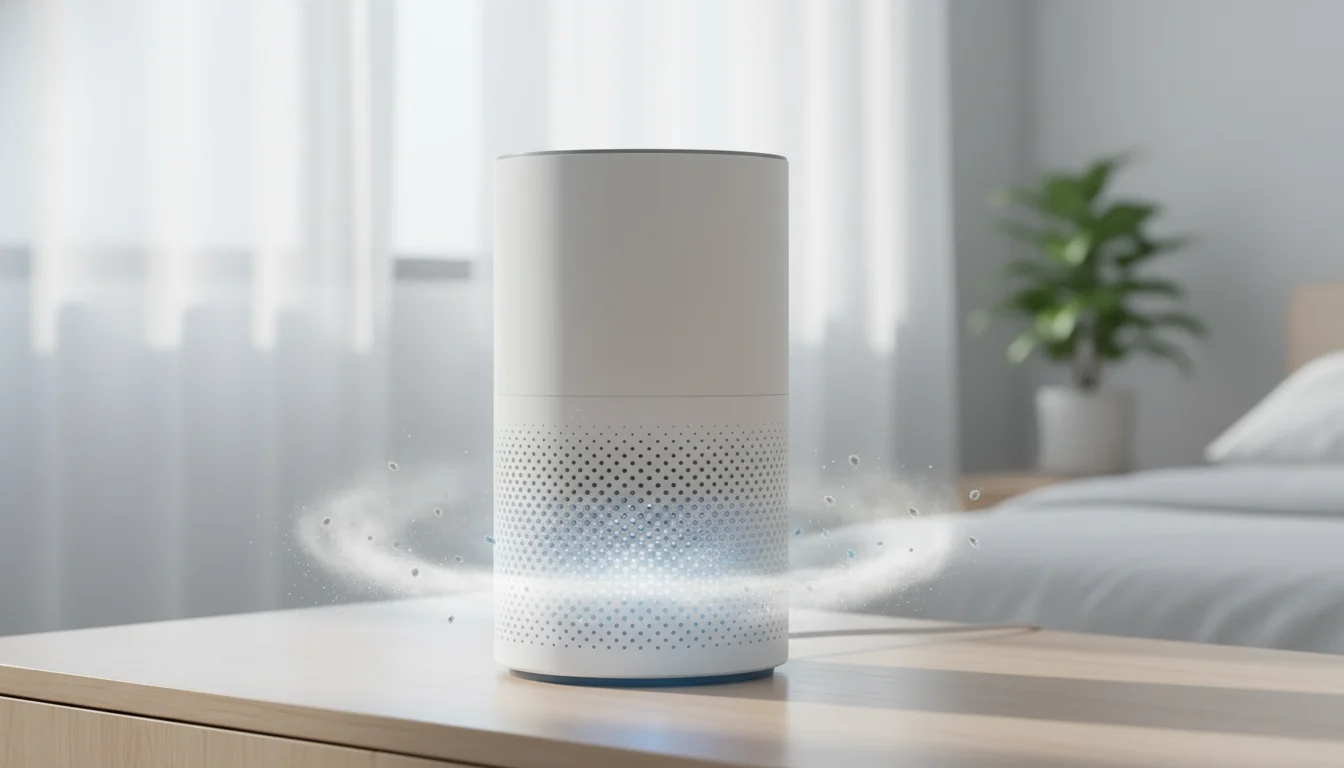
Dust mite allergies affect roughly 20 million Americans, and at least 84% of U.S. households harbor detectable dust mite populations. A common misconception is that air purifiers kill dust mites—they don't. Air purifiers capture airborne allergens but cannot kill mites living in mattresses and fabrics. This guide explains what air purifiers actually do, which filter types work best, and how to combine strategies for real relief.
I spent three months convinced my HEPA purifier was failing because I still woke up congested. Then I learned dust mites were breeding happily in my pillow while I filtered empty air. That realization changed everything about how I approached allergy control.
Understanding Dust Mites and Their Allergens
Dust mites live embedded in bedding, carpets, and upholstered furniture—not floating through your home. The allergic reactions you experience come from proteins in dust mite feces and body fragments, which measure 10–40 microns and become airborne through everyday activities like walking or making your bed.
| Allergen Source | Size | Where It Lives | How It Becomes Airborne |
|---|---|---|---|
| Dust mite feces | 10–40 microns | Mattresses, pillows, carpets | Walking, vacuuming, bed-making |
| Body fragments | 10–40 microns | Upholstery, stuffed toys | Movement, cleaning, shaking fabrics |
| Der p 1 protein | Microscopic | Fecal pellets | Disturbance of settled dust |
This size range matters because HEPA filters capture particles down to 0.3 microns with 99.97% efficiency. Dust mite allergens are significantly larger, making them among the easiest particles for HEPA filtration to trap. According to the Allergy and Asthma Network, the distinction between killing mites and removing their allergens represents two completely different challenges.
How Air Purifiers Capture Dust Mite Allergens
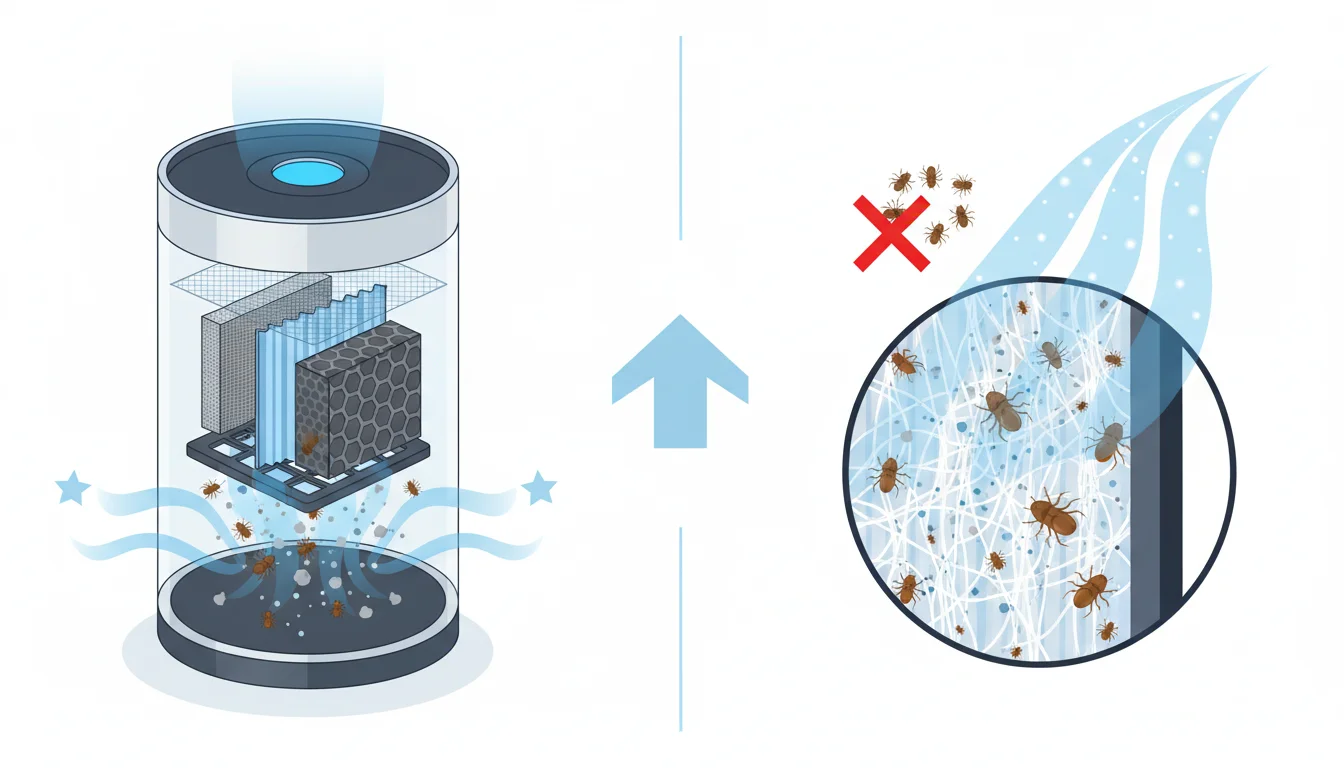
HEPA filters mechanically trap 99.97% of particles 0.3 microns and larger, which includes all dust mite allergens given their 10–40 micron size. Filtration happens through a dense mesh that forces air through increasingly fine layers, capturing particles too large to pass through.
The capture process works like this: you walk across a carpet or pull back your bedcovers, launching dust mite feces and fragments into the air. These particles stay suspended briefly before settling. During that airborne window, your purifier pulls contaminated air through the HEPA filter and releases clean air.
| Factor | Optimal Setting | Why It Matters |
|---|---|---|
| Air changes per hour (ACH) | 4–6 per hour | More cycles mean more allergens captured before settling |
| CADR rating | Matches room size | Undersized units leave allergens in circulation |
| Filter certification | True HEPA only | HEPA-type filters miss particles under 2 microns |
| Runtime | Continuous | Allergens become airborne unpredictably |
Research from the American Academy of Pediatrics found that children in homes with HEPA-filtered systems experienced fewer asthma episodes than those using standard cleaning methods alone. Fair warning: air purifiers only work on airborne particles, not the mites reproducing in your mattress.
HEPA vs. Other Filter Types for Dust Mite Control
True HEPA filters outperform every alternative technology for capturing dust mite allergens due to their certified mechanical filtration efficiency. HEPA-type or HEPA-like filters lack standardized testing and typically capture only 85–90% of particles, allowing thousands of allergen particles to recirculate.
| Filter Type | Dust Mite Allergen Capture | Certification Standard | Limitations |
|---|---|---|---|
| True HEPA | 99.97% at 0.3 microns | DOE certified | Requires filter replacement |
| HEPA-type | 85–90% at 2+ microns | None | Misses smaller particles |
| Activated carbon | 0% (designed for gases) | N/A | Cannot capture particulates |
| UV-C | Limited airborne kill | None for allergens | Cannot reach mites in surfaces |
| Ionizers | Variable | None | May produce ozone as byproduct |
Carbon filters absorb odors and gases but do nothing for particulate allergens. UV-C technology damages microorganism DNA, but mites hiding in your mattress never pass through the light chamber. The EPA HEPA standards exist precisely because generic filter claims proved unreliable. If the box says "HEPA-like" or "99% HEPA," walk away.
Optimal Air Purifier Placement and Settings
Position your air purifier in the bedroom within 6–10 feet of your bed with no furniture blocking airflow. You spend 6–8 hours each night breathing air closest to your mattress, making placement critical. Run the unit continuously on medium-high speed—not just at night.
| Placement Factor | Recommendation | Common Mistake |
|---|---|---|
| Distance from bed | 6–10 feet | Placing in corner away from sleep zone |
| Height | 3–5 feet off floor | Floor placement limits circulation |
| Airflow direction | Unobstructed intake and output | Blocked by curtains or furniture |
| Room coverage | CADR rated for actual room size | Using bedroom unit for living room |
| Operating schedule | 24/7 continuous | Running only at night |
The 4–6 air changes per hour target means a room's entire air volume passes through the filter 4–6 times every hour. Your bedroom is ground zero for dust mite exposure because your body heat and humidity create ideal mite breeding conditions in your mattress.
Complementary Dust Mite Control Methods
Air purifiers alone fail to control dust mite populations because filtration addresses only airborne allergens while mites continue breeding in your bedding and soft furnishings. One controlled study found that HEPA air purifiers did not significantly reduce indoor dust mite allergen levels or improve rhinitis symptoms when used as the sole intervention.
| Control Method | Frequency | Temperature/Setting | Impact |
|---|---|---|---|
| Wash bedding | Weekly | 130°F (54°C) minimum | Kills mites and removes allergens |
| Allergen-proof encasements | Permanent | N/A | Blocks mite colonization |
| Humidity control | Continuous | Below 50% | Inhibits mite reproduction |
| HEPA vacuuming | 2x weekly | Sealed system | Removes settled allergens |
| Remove carpets | One-time | N/A | Eliminates mite habitat |
The AAFA emphasizes that complete dust mite elimination is impossible, but reducing exposure through multiple methods lessens allergic reactions. I started washing sheets at 130°F and noticed the difference within two weeks. Keeping humidity below 50% makes your home inhospitable to mites, since they absorb moisture from the air rather than drinking water.
What Research Says About Air Purifier Effectiveness
Clinical studies confirm that HEPA air purifiers significantly reduce airborne allergen concentrations when operating continuously in properly sized rooms. The Journal of Allergy and Clinical Immunology documented measurable symptom improvements among allergy sufferers using HEPA filtration systems.
| Study Finding | Context | Implication |
|---|---|---|
| Reduced airborne allergens | Continuous HEPA operation | Lower inhalation exposure |
| Fewer asthma episodes | Children with HEPA systems | Measurable health outcome |
| No symptom improvement | HEPA alone, no other measures | Filtration insufficient as sole strategy |
| Variable real-world results | Home conditions differ | Severity and compliance affect outcomes |
The research consensus is clear: air purification works for airborne particles but requires complementary source control. Homes with severe infestations, wall-to-wall carpet, and humidity problems see less benefit than those addressing the complete allergen cycle.
FAQ
Do air purifiers kill dust mites directly?
No. Air purifiers capture airborne allergens but cannot kill dust mites living in mattresses, pillows, and carpets. The mites remain embedded in soft surfaces where air purifiers cannot reach them.
How long should I run my air purifier for dust mite allergies?
Run your air purifier continuously, 24 hours per day. Allergens become airborne unpredictably through normal activities, and consistent filtration catches particles whenever they enter the air.
What CADR rating do I need for dust mite allergen control?
Choose a purifier with a CADR rating that matches or exceeds your room's square footage. For a 200-square-foot bedroom, select a unit rated for at least 200 square feet on its highest setting.
Will an air purifier help with dust mite allergies if I have carpet?
It helps but provides limited relief. Carpet harbors millions of dust mites that continuously release allergens. Consider removing carpet in bedrooms, or vacuum twice weekly with a HEPA-sealed vacuum.
Can I use an ionizer instead of a HEPA filter for dust mites?
HEPA filters outperform ionizers for allergen capture. Some ionizers produce ozone as a byproduct, which irritates airways and worsens asthma symptoms. Stick with true HEPA filtration.
How often should I replace my HEPA filter for optimal allergen removal?
Replace HEPA filters every 6–12 months depending on usage and manufacturer guidelines. Clogged filters reduce airflow and capture efficiency, allowing more allergens to circulate.
Do I need an air purifier in every room for dust mite control?
Prioritize the bedroom, where you spend 6–8 hours sleeping near your mattress. Secondary priority goes to living spaces where you spend extended time on upholstered furniture.
What humidity level kills dust mites?
Dust mites cannot survive when humidity stays below 50% for extended periods. Use a dehumidifier alongside your air purifier to create conditions where mites cannot reproduce or survive.
Share this post
Related Posts
UV Air Purifier for HVAC: Complete 2025 Guide to Cleaner Indoor Air
UV Air Purifier for HVAC: Complete 2025 Guide to Cleaner Indoor Air
Air Purifier With Window Open: Does It Work? (2025 Guide)
Air Purifier With Window Open: Does It Work? (2025 Guide)
Air Purifiers for Cigarette Smoke: What Actually Works (2025 Guide)
Air Purifiers for Cigarette Smoke: What Actually Works (2025 Guide)