10 Disadvantages of Air Purifiers You Need to Know Before Buying
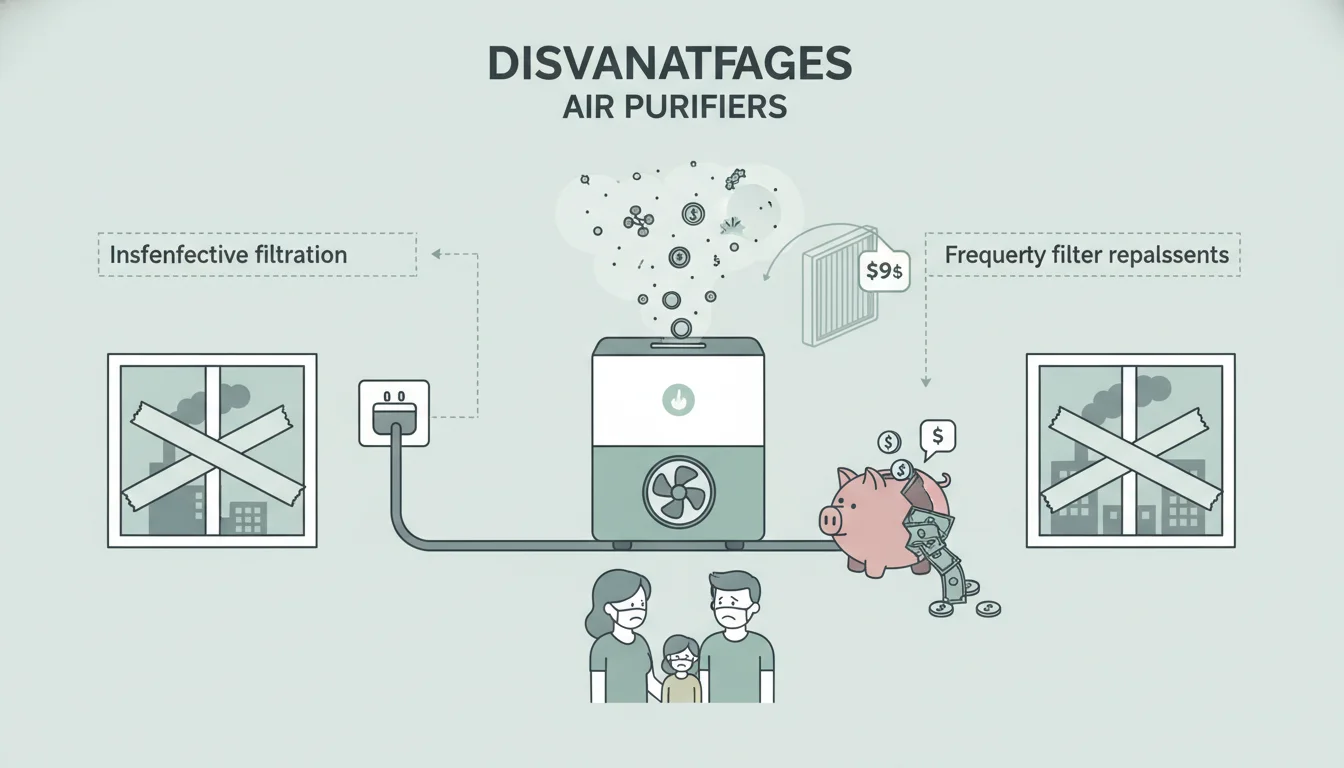
Air purifiers remove airborne particles like dust, pollen, and smoke from indoor spaces using filtration or electronic charging methods. The global air purifier market reached $14.6 billion in 2024, yet Consumer Reports found that annual filter replacement costs alone range from $104 to $140 for recommended models. This guide covers the disadvantages of air purifiers, from hidden expenses and noise problems to serious health risks from ozone generation.
High Ongoing Maintenance Costs and Filter Replacement Expenses
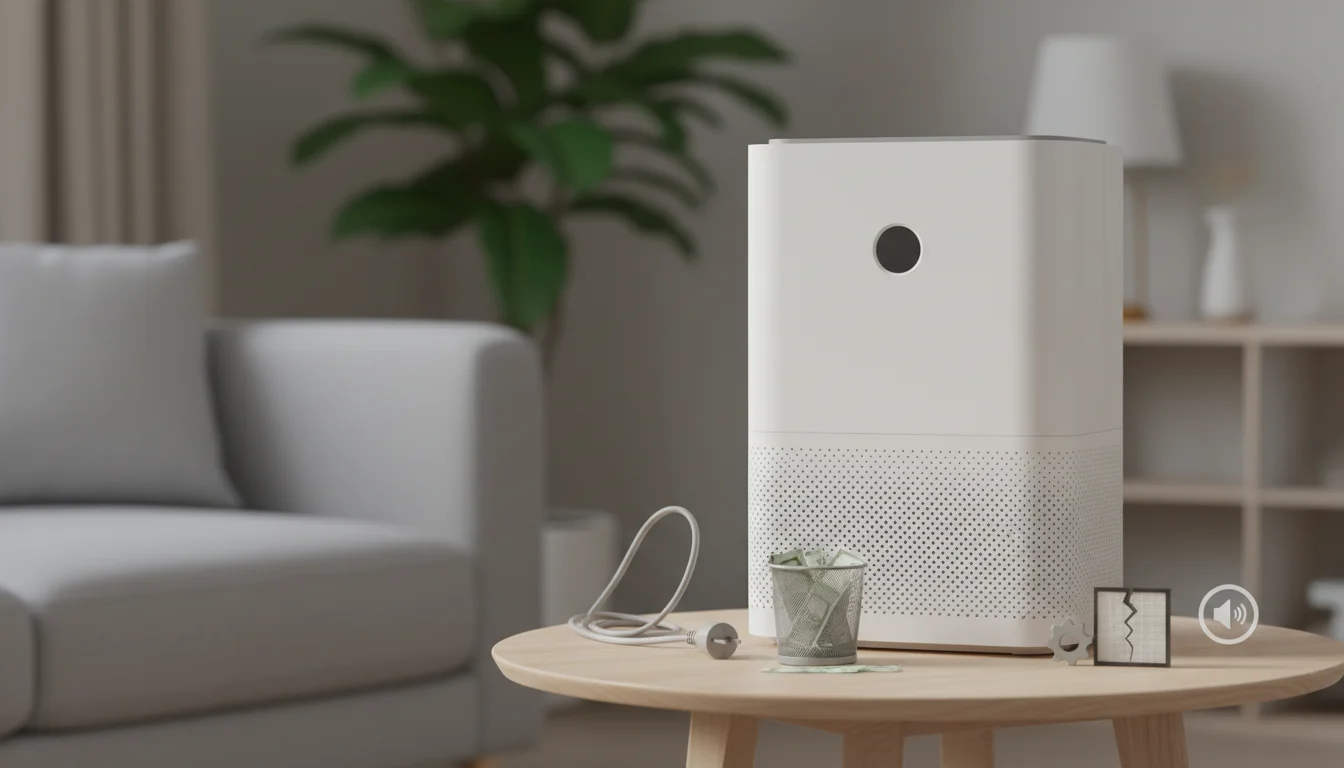
The total cost of owning an air purifier over five years often approaches double the initial purchase price due to mandatory filter replacements and electricity consumption.
HEPA filters need replacement every 6 to 12 months, costing $30 to $200 per filter depending on the model. Carbon filters for odor control require changes every 3 to 6 months at $50 per replacement. A $600 purifier with both filter types costs roughly $154 annually in maintenance alone.
| Filter Type | Replacement Frequency | Cost Per Replacement | Annual Cost |
|---|---|---|---|
| HEPA | 6-12 months | $30-$200 | $60-$200 |
| Activated Carbon | 3-6 months | $20-$50 | $40-$200 |
| Pre-filter | 1-3 months | $10-$30 | $40-$360 |
Neglecting filter replacement creates a worse problem than having no purifier at all. Clogged filters lose their ability to capture pollutants and become contamination sources, releasing trapped particles and mold spores back into your breathing space. According to [Eco Green Pro], failing to replace filters as recommended leads to reduced air quality and potential health risks for people with respiratory conditions.
Noise Pollution and Sleep Disruption
Running an air purifier creates a constant trade-off between purification strength and livable noise levels, with higher fan speeds producing sounds comparable to vacuum cleaners.
Most air purifiers generate 30 to 70 decibels depending on the setting. Low speeds hover around 20 to 45 dB, similar to a whisper or quiet library. High speeds reach 60 to 70 dB, matching a washing machine or conversation in a crowded restaurant.
| Setting | Noise Level | Comparable Sound | Sleep Impact |
|---|---|---|---|
| Low | 20-45 dB | Whisper, library | Minimal |
| Medium | 40-55 dB | Refrigerator hum | Moderate |
| High | 60-70 dB | Vacuum cleaner | Significant |
Bedroom use presents a real challenge. Sleep experts recommend keeping noise below 40 dB for quality rest, but effective purification often requires medium or high settings. I tested three different purifiers in my bedroom and found myself choosing between breathing cleaner air or actually sleeping through the night. According to [House Fresh], only premium models maintain sub-45 dB operation while delivering strong filtration performance.
Ozone Generation and Serious Health Risks
Ionizers and electrostatic precipitators produce ozone as a byproduct—a gas that irritates airways and worsens respiratory conditions even at low concentrations.
Ozone exposure causes chest pain, coughing, throat irritation, and shortness of breath. The gas reacts with indoor chemicals to create additional toxic byproducts, including formaldehyde and ultrafine particles. People with asthma experience symptom flare-ups and reduced lung function from ozone levels well below detectable thresholds.
The regulatory landscape offers limited protection for consumers:
- California banned ozone generators for home use entirely
- The FDA limits ozone output to 50 parts per billion for indoor medical devices
- OSHA sets workplace exposure limits at 100 ppb over 8 hours
- Consumer air purifiers face no comprehensive federal regulation
According to the U.S. EPA, ozone generators sold as air cleaners do not effectively remove chemical pollutants or odors despite marketing claims. The [California Air Resources Board] warns that misleading advertising allows dangerous products to remain on the market.
To avoid ozone-generating purifiers, check for CARB certification, choose HEPA or activated carbon models, and avoid anything marketed as "activated oxygen" or "pure air" technology.
Limited Effectiveness and Coverage Area Restrictions
Air purifiers work within a specific square footage range and fail to remove many common indoor pollutants regardless of filter quality or price point.
Every purifier has a Clean Air Delivery Rate (CADR) specifying the volume of filtered air it produces per minute. A unit rated for 400 square feet performs poorly in a 600-square-foot room. Opening doors or windows drops effectiveness by 40 to 60 percent as untreated air constantly enters the space.
| Pollutant Type | HEPA Effectiveness | Carbon Effectiveness | Notes |
|---|---|---|---|
| Dust, pollen | 99.97% | Low | Particles must reach filter |
| Smoke particles | 95%+ | Moderate | Fine particles escape |
| VOCs, gases | None | 60-80% | Requires frequent replacement |
| Embedded carpet particles | None | None | Vacuuming required |
| Mold on surfaces | None | None | Source removal needed |
Marketing claims regularly exaggerate real-world performance. Laboratory CADR ratings test purifiers in sealed chambers with continuous pollutant generation. Your living room has furniture blocking airflow, pets stirring up particles, and cooking odors that overwhelm carbon filters within weeks. The difference between advertised and actual performance surprised me after six months of air quality testing.
Mold, Bacteria Accumulation, and VOC Emissions
Dirty filters become breeding grounds for the exact contaminants you bought the purifier to remove, creating a machine that actively degrades your air quality.
Mold spores and bacteria thrive in the moist, particle-rich environment of a used filter. When the fan runs, it pushes contaminated air back into your room. Some plastic purifier components also release volatile organic compounds when heated by motor operation, adding chemical pollution to biological contamination.
Warning signs your filter has become a contamination source:
- Musty or stale odor when the purifier runs
- Visible discoloration or dark spots on filter media
- Reduced airflow despite a clean pre-filter
- Allergy symptoms worsening when the purifier operates
The fix requires strict adherence to replacement schedules, which brings you back to the ongoing cost problem. Skip a filter change to save $100, and you risk creating a mold dispersal device in your bedroom.
Energy Consumption and Environmental Impact
Running an air purifier continuously adds $50 to $150 annually to your electricity bill while generating landfill waste from disposable filters every few months.
Most purifiers draw 30 to 100 watts on medium settings. At the national average electricity rate of $0.16 per kilowatt-hour, a 50-watt purifier running 24/7 costs about $70 per year. Higher-performance units with stronger fans push annual energy costs above $150.
| Purifier Type | Watts (Medium) | Annual kWh | Annual Cost |
|---|---|---|---|
| Compact HEPA | 30-40 | 263-350 | $42-$56 |
| Mid-size HEPA | 50-70 | 438-613 | $70-$98 |
| Large room HEPA | 80-100 | 700-876 | $112-$140 |
| Whole-house | 150-300 | 1,314-2,628 | $210-$420 |
The environmental calculation grows more complicated when you factor in waste. Disposable HEPA and carbon filters contain synthetic materials that persist in landfills. Manufacturing and shipping purifiers from overseas factories adds to the carbon footprint. Whether the air quality benefits outweigh these environmental costs depends on your specific pollution exposure and the alternatives available.
When Air Purifiers Make Sense (And When They Don't)
Air purifiers deliver genuine value in specific situations while wasting money in others, making your individual circumstances the deciding factor.
The investment makes sense when you have documented allergies or asthma triggered by airborne particles, live near wildfires or industrial pollution sources, share space with smokers, or have immunocompromised family members. These situations create measurable health risks that purifiers directly address.
Skip the purifier when your issues stem from poor ventilation, surface dust, or outdoor air leaking through gaps. Better solutions for these problems include:
- Opening windows during low-pollution hours for free air exchange
- Sealing air leaks around doors and windows
- Removing carpeting that traps allergens
- Running bathroom exhaust fans during and after showers
- Addressing mold at the source instead of filtering spores
Fair warning: houseplants do not purify air at meaningful rates despite popular claims. NASA's famous plant study used sealed chambers with no real-world application. You would need hundreds of plants to match a basic HEPA purifier.
FAQ
Do air purifiers remove viruses and bacteria from the air?
HEPA filters capture virus-carrying droplets larger than 0.3 microns with 99.97% efficiency. Airborne viruses themselves measure 0.1 microns or smaller and pass through standard filters. UV-C purifiers kill pathogens but require extended exposure times that fast-moving air prevents.
How long should I run my air purifier each day?
Continuous operation provides the best air quality but increases costs and filter wear. Running the purifier for 8 to 12 hours during occupied periods offers a reasonable compromise. Turn it off when windows are open, since you waste electricity filtering infinite outdoor air.
Are expensive air purifiers worth the higher price?
Premium models offer quieter operation, larger coverage areas, and better build quality. The filtration technology remains largely identical across price points. Spending more on the initial purchase often means lower noise but similar or higher ongoing filter costs.
Can air purifiers help with pet allergies?
HEPA filters effectively capture pet dander, the primary allergen trigger. However, they do not remove allergens embedded in furniture, carpeting, or bedding. Combining purifier use with regular vacuuming and pet grooming produces better results than either approach alone.
Do I need an air purifier if I have central air conditioning?
Central HVAC systems with MERV 13 or higher filters remove many of the same particles as standalone purifiers. The filtration only occurs when the system runs, leaving gaps during mild weather. Portable purifiers provide continuous cleaning in specific rooms regardless of HVAC cycling.
What size air purifier do I need for my room?
Match the purifier's CADR rating to your room's square footage, then add 20% for doors, movement, and airflow obstructions. A 300-square-foot bedroom needs a purifier rated for at least 360 square feet. Undersized units run constantly on high settings, increasing noise and energy costs.
How do I know when to replace my air purifier filters?
Most purifiers include filter replacement indicators based on runtime hours. These estimates assume average conditions and miss heavy-use periods. Check filters monthly through visual inspection for discoloration, reduced airflow, or odors that signal contamination before the timer expires.
Share this post
Related Posts
UV Air Purifier for HVAC: Complete 2025 Guide to Cleaner Indoor Air
UV Air Purifier for HVAC: Complete 2025 Guide to Cleaner Indoor Air
Air Purifier With Window Open: Does It Work? (2025 Guide)
Air Purifier With Window Open: Does It Work? (2025 Guide)
Air Purifiers for Cigarette Smoke: What Actually Works (2025 Guide)
Air Purifiers for Cigarette Smoke: What Actually Works (2025 Guide)